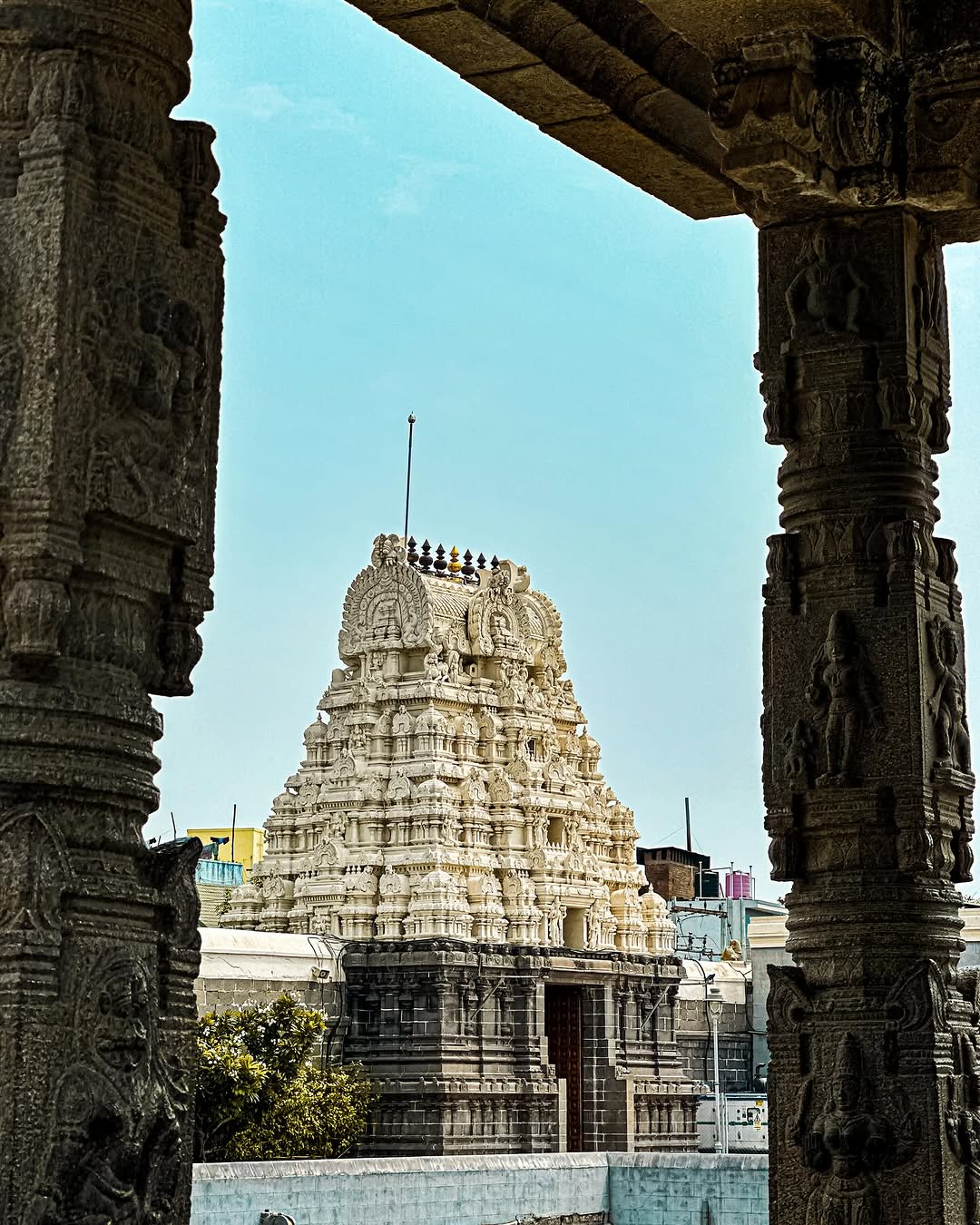
Kanchipuram, Tamil Nadu
Kamakshi Amman Temple
Also known as: Kamakoti Nayagi Kovil, Nabhi Peetham / Odhyana Peetham, Sri Kamakshi Devi/Maha Tripurasundari Temple, Kamakoti Peetham
A supremely revered Shakti shrine in the historic city of Kanchipuram, famous for the powerful Sri Chakra installed by Adi Shankaracharya. Regarded as the Earth's 'Navel' (Nabhi Peetham), this temple sits at the heart of a city-wide sacred geometric grid. A pilgrimage here is a complete spiritual and cultural immersion, seamlessly blending cosmic energy, ancient traditions, world-renowned silk sarees, and the iconic Kanchipuram Kovil Idli.
The History
According to historical and spiritual texts, the Goddess here originally manifested in a very fierce (Ugra) form. In the 8th century, the great philosopher and saint Adi Shankaracharya visited the temple. To pacify her fierce nature and channel her energy into a peaceful, benevolent form (Shanta Swaroopa), he composed the Saundarya Lahari and installed a highly potent Sri Chakra (a geometric mystic diagram) just in front of the main idol.
Since then, the temple has been deeply intertwined with the Kanchi Kamakoti Peetham, a monastic institution established by Shankara. Today, it stands as one of the most important centers for the Sri Vidya tradition of Goddess worship.
Sacred Architecture
The Gayatri Mandapam and the Triadic Power Grid
The main sanctum (Garbhagriha) of the temple is the deeply revered Gayatri Mandapam. It is an architectural masterpiece supported by exactly 24 pillars, which symbolize the 24 letters of the sacred Gayatri Mantra, while its four walls represent the four Vedas. At the center of this mandapam, Goddess Kamakshi sits in a yogic Padmasana (lotus posture) upon the Panch Brahmasan. She holds a sugarcane bow and arrows of flowers in her lower hands, and a pasha (noose) and ankusha (goad) in her upper hands.
Directly in front of the deity sits the highly potent Sri Chakra installed by Adi Shankaracharya. Another profoundly sacred feature inside the sanctum is a silver-covered pillar with a small hole representing the Nabhi (navel) of the Goddess. Devotees seeking the blessing of children (Santati) pray specifically at this pillar.
Beyond the sanctum, Kanchipuram hides one of India’s greatest ancient mysteries: the city was engineered as a giant temple, operating as an advanced Triadic Power Grid. The massive Gopurams (towers) act as atmospheric receivers, catching cosmic energy and funneling it downward. Inside the Kamakshi temple, the Sri Chakra acts as a spiritual 'voltage regulator,' pacifying this fiery energy so it is accessible to human devotees. Energy flows constantly between the three main vertices—Kamakshi Amman, Ekambareswarar, and Varadharaja Perumal—creating a geometric triangle that keeps the city spiritually 'live' 24/7. Standing in the Kamakshi sanctum is a physical immersion into a high-quartz granite 'battery,' designed to reset the nervous system through magnetic resonance.
The temple complex, spanning 5 acres, also hides profound biological and spiritual mysteries in its stonework. Throughout the architecture, one can find stunningly accurate carvings of embryology—such as the mysterious depiction of a woman with a visible fetus inside her womb. These carvings, created thousands of years before modern ultrasounds, stand as a testament to the ancient Rishis' deep understanding of life before birth and their supreme reverence for Garbh Sanskar (the sanctity of divine motherhood).
Legend of the Deity
According to local lore, Goddess Parvati performed intense penance under a sacred mango tree in Kanchipuram, making a Shivalingam out of sand to seek Lord Shiva’s hand in marriage. This divine union is honored at the nearby Ekambareswarar Temple.
Another prominent legend states that the Goddess manifested here to annihilate the demon Bhandasura. Because Kamakshi absorbed all the 'Shakti' (divine feminine energy) to defeat the demon, none of the many Shiva temples in the city have a separate shrine for Parvati—Kamakshi rules as the absolute, solitary empress of the city.
Spiritually, Kanchipuram is revered as the Earth's Nabhi Peetham (the navel point), a cosmic center where spiritual energy for the entire planet is processed. A deeply held local truth states that if a devotee performs exactly 9 Pradakshinas (circumambulations) around the temple and stands before Amma with a pure, righteous wish, she will invariably clear their obstacles and fulfill their prayer.
Worship & Rituals
Instead, all Abhishekam and daily bathing rituals are performed on the Utsava Murti (the metal processional idol) and the sacred Sri Chakra placed in front of the Goddess. The Sri Chakra is worshipped as the geometric, sonic representation of the supreme Goddess herself.
For pilgrims, the spiritual journey involves performing the sacred 9 Pradakshinas for wish fulfillment. The journey is also a sensory one—many devotees complete their temple visits by indulging in the city's legendary culinary offering, the spiced, ginger-and-pepper-infused Kanchipuram Kovil Idli, originally popularized as temple prasadam.
Festivals
Navaratri (September-October) is celebrated with supreme devotion and grandeur. The Goddess is adorned in breathtakingly beautiful Alankarams (forms) every day, and traditional Carnatic music and dance performances echo throughout the temple complex.
Other major celebrations include Aadi Pooram (celebrating the Goddess's arrival), Sankara Jayanti (honoring Adi Shankaracharya), and the auspicious Fridays of the Tamil months of Aadi and Thai, which draw massive crowds of devotees.
⏳ Daily Schedule
12:15 PM - 04:00 PM: Temple Closed
04:00 PM - 08:15 PM: Evening Darshan
08:15 PM: Night Puja & Temple Closes
Associated Shrines
Ekambareswarar Temple
Husband of Kamakshi (Lord Shiva)
One of the Pancha Bhoota Stalas (representing Earth). It is the site where Kamakshi is believed to have worshipped the sand Shivalingam.
Kumarakottam Temple
Son of Kamakshi and Shiva (Lord Murugan)
Located exactly between the Kamakshi and Ekambareswarar temples, representing the 'Somaskanda' formation (Father-Son-Mother).
Varadharaja Perumal Temple
Brother of Kamakshi (Lord Vishnu)
One of the most sacred Vaishnavite Divya Desams. A visit here is incomplete without touching the legendary Golden and Silver Lizards carved on the ceiling, believed to cleanse all past sins and bring ultimate good luck.
Ulagalantha Perumal Temple
Form of Lord Vishnu (Vamana/Trivikrama)
Located very close to the Kamakshi temple; historically and architecturally linked to the same sacred geography.