Belur, Hassan District, Karnataka, India
Sri Chennakeshava Temple
Also known as: Vijayanarayana Temple, Belur Temple, Keshava Temple
Situated on the banks of the Yagachi River, the Sri Chennakeshava Temple is the breathtaking crown jewel of Hoysala architecture. Unlike many ancient ruins, this is a 'living temple' where worship has continued uninterrupted for over 900 years. The name 'Chennakeshava' literally translates to 'Handsome Vishnu', a fitting name for a deity housed in a temple famous for its impossibly intricate, jewelry-like stone carvings.
The History
Sacred Architecture
Soapstone Mastery and the Madanikas
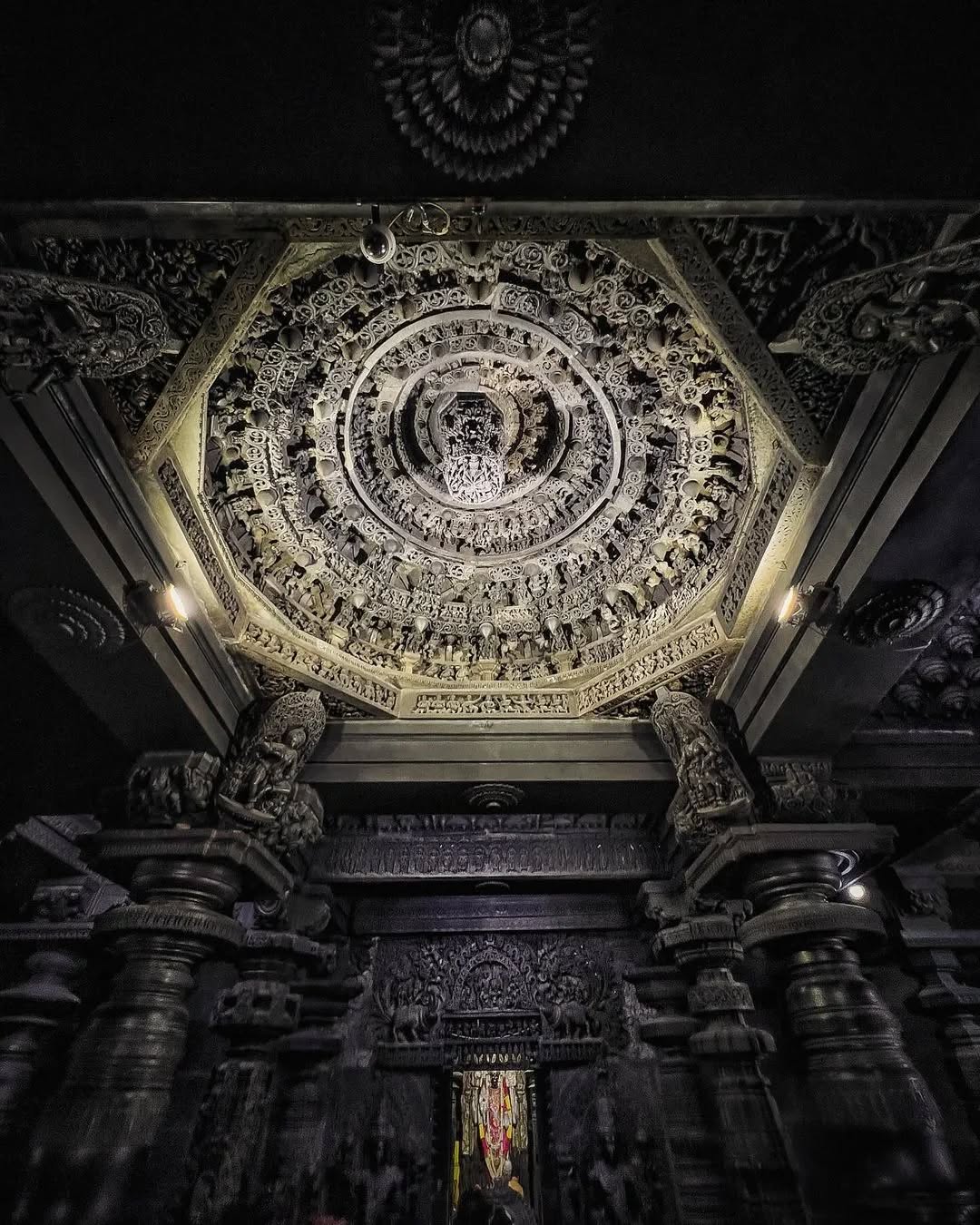
The temple is built on a signature Hoysala Jagati (a raised, star-shaped platform) that allows devotees to circumambulate while viewing the exterior carvings. It is constructed entirely from Chloritic Schist (Soapstone), a unique material that is soft and buttery when first quarried—allowing artisans to carve it like woodwork or jewelry—but hardens into solid rock over time when exposed to the air. The absolute highlight of the temple are the 42 Madanikas (bracket figures) depicting celestial dancing maidens, the most famous being the 'Darpana Sundari' (Lady with the Mirror). Inside, the 'Narasimha Pillar' is an engineering marvel that could once be rotated on its ball-bearing base.Legend of the Deity
Worship & Rituals
The folklore of Belur is dominated by the legendary master sculptor, Amarashilpi Jakanachari. According to legend, Jakanachari left his pregnant wife to build temples across the empire. Years later, a young man arrived at Belur and boldly claimed that one of the main stone images carved by Jakanachari had a flaw (a toad hidden inside). Enraged, Jakanachari vowed to cut off his own right hand if a flaw was found. The youth broke the stone, revealing a toad and some water. Jakanachari kept his vow and severed his hand, only to discover the young man was his own son, Dankanachari. Though historians debate Jakanachari's actual existence, his name is synonymous with Karnataka's sculptural genius to this day.
Festivals
⏳ Daily Schedule
(Note: ASI-certified guides are highly recommended here, as every single inch of the walls and pillars tells a specific, complex story from the epics.)
Associated Shrines
Hoysaleshwara Temple, Halebidu
Sister Heritage Site
Located just 16 km away, this is the Shaivite counterpart to Belur. Though the Halebidu temple is vastly larger and more intricately carved on the outside, it is incomplete and worship is limited, making it a perfect historical contrast to the active Belur temple.