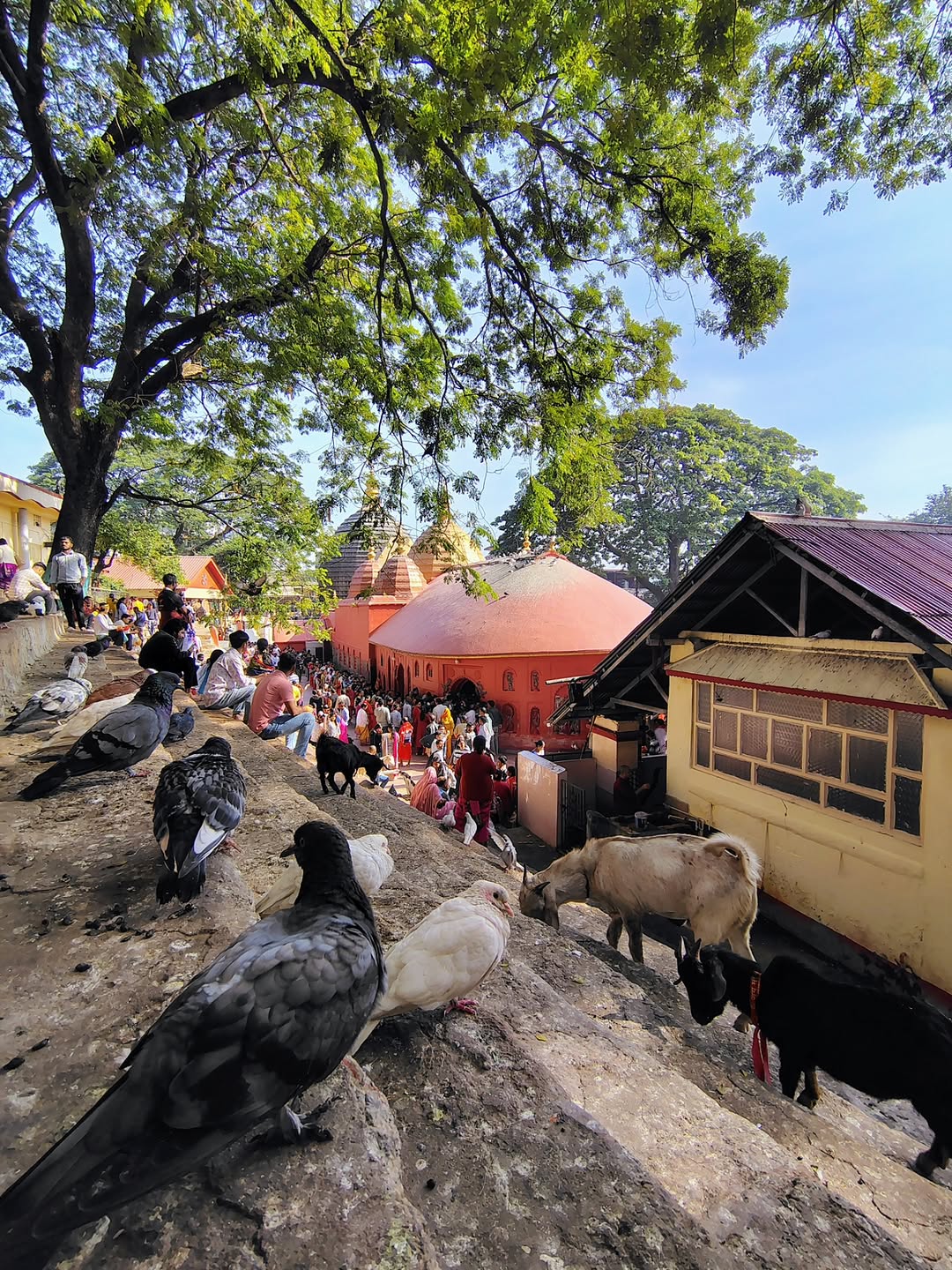
Guwahati, Assam
Kamakhya Temple
Also known as: Kamrup Kamakhya, Kamakhya Devalaya
Situated on the Nilachal Hill, it is one of the oldest and most revered of the 51 Shakti Peethas, serving as the epicenter of Tantric Shaktism and celebrating the divine feminine power of creation.
The History
The original ancient structure is believed to have been destroyed during the early 16th century. The temple as it stands today was rebuilt in 1565 CE by Chilarai, the legendary military general and brother of the Koch King Naranarayan. Following the Koch dynasty, the temple received immense patronage from the Ahom kings of Assam, who became devout followers of the Shakta tradition and built many of the surrounding structures.
For centuries, Kamakhya has been universally recognized as the absolute epicenter of Tantric worship in South Asia. Sages, scholars, and tantrics have historically journeyed here to master esoteric practices, making it a living repository of ancient mystical traditions.
Sacred Architecture
Nilachal Architectural Style
The Kamakhya Temple represents a unique hybrid architectural style known as the Nilachal type, which evolved due to the integration of the traditional Hindu temple structures with Islamic architectural influences brought in by local artisans during its 16th-century reconstruction.
The temple features a hemispherical dome (similar to a stupa or a mosque dome) resting on a cruciform base. The outer walls of the temple are adorned with intricately carved stone panels depicting Ganesha, other Hindu deities, and various floral motifs.
The temple consists of four distinct chambers: the Garbhagriha (inner sanctum), and three mandapas known locally as the Calanta, Pancaratna, and Natamandira. The Garbhagriha is actually a dark, subterranean cave accessed via a flight of steep stone steps. Within this cave, there is no sculpted idol or image; instead, the Goddess is worshipped in the form of a yoni-shaped rock fissure, naturally kept moist by an underground spring.
Legend of the Deity
To save the universe from Shiva's wrath, Lord Vishnu used his Sudarshana Chakra to dismember Sati's body. The body parts fell across the Indian subcontinent, creating the 51 Shakti Peethas. It is believed that Sati's Yoni (womb/genitals) fell on the Nilachal Hill, making Kamakhya the supreme seat of female fertility and the cosmic womb of creation.
Another legend states that Kamadeva (the god of love) sought out the Goddess's womb to cure himself of a curse that had cost him his physical beauty. Upon being cured, he built a temple to the Goddess, naming the deity Kamakhya (the Goddess of Desire).
Worship & Rituals
The central focus of worship in the Garbhagriha is the natural rock fissure representing the Goddess's yoni. Devotees offer flowers, vermilion (sindoor), and lengths of red cloth directly onto the sacred spring. Animal sacrifice (Bali), particularly of male goats, buffaloes, and pigeons, has historically been a significant part of the Shakta worship here to appease the fierce aspects of the Goddess.
The prasadam distributed at the temple directly reflects these dual traditions. A daily Bhog is served to devotees around 12:00 PM to 1:00 PM at the Annapurna Bhojanalaya, featuring comforting traditional fare like khichdi, payokh (kheer), mixed vegetables, and papad. However, true to its Vamachara roots, the temple also uniquely offers non-vegetarian prasadam, including goat meat and fish, particularly after the temple reopens post-Ambubachi Mela.
Another highly sacred form of worship is the Kumari Puja, where young, pre-pubescent girls are seated, their feet washed, and they are worshipped with offerings and mantras as living incarnations of the Divine Mother.
Festivals
On the fourth day, the doors are thrown open, and massive crowds gather to receive the Goddess's blessings and the highly sought-after Rakta Bastra (a sacred red cloth supposedly soaked in the menses) and packets of Sindoor (vermilion), which are revered as ultimate symbols of cosmic fertility and power.
Durga Puja (Navaratri) is another massive celebration, celebrated uniquely at Kamakhya. Rather than just nine days, the festival here extends for an entire fortnight (Paksha), involving elaborate Tantric rituals, Kumari Puja (worship of young virgin girls as embodiments of the Goddess), and traditional offerings.
⏳ Daily Schedule
08:00 AM - 01:00 PM: General Darshan
01:00 PM - 02:30 PM: Temple Closed (Bhog/Offerings)
02:30 PM - 05:30 PM: General Darshan
05:30 PM: Temple Closes for Darshan
06:00 PM - 07:30 PM: Evening Aarti
Associated Shrines
The Dasa Mahavidya Temples
The Ten Cosmic Forms of the Divine Mother
The Kamakhya complex is unique as it houses individual temples for all ten Mahavidyas: Kali, Tara, Tripura Sundari (Sodashi), Bhuvaneshwari, Bhairavi, Chhinnamasta, Dhumavati, Bagalamukhi, Matangi, and Kamala.
Umananda Temple
Bhairav of Kamakhya (Lord Shiva)
Located on Peacock Island in the middle of the Brahmaputra River. It is essential for pilgrims to visit Umananda before or after visiting Kamakhya to complete the pilgrimage.
Navagraha Temple
Planetary Deities
An ancient center for astrology and astronomy located on Chitrachal Hill in Guwahati, historically linked to the spiritual ecosystem of the region.