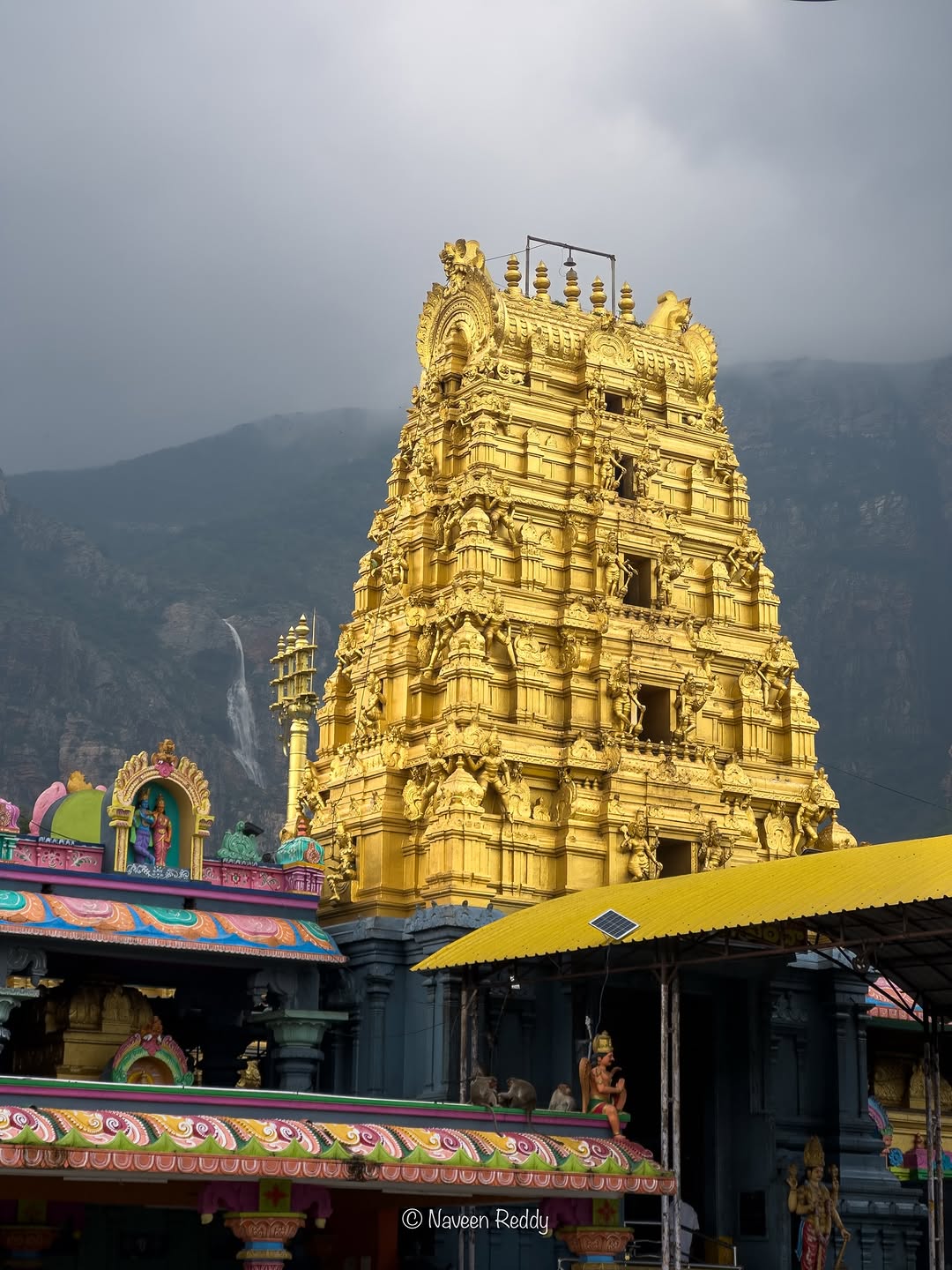
Penchalakona, Nellore District, Andhra Pradesh, India
Sri Penusila Lakshmi Narasimha Swamy Temple
Also known as: Pechalakona Temple, Penchalakona Narasimha Swamy
VaishnavismForest ShrineHill TemplePilgrimagePancha Narasimha KshetrasPenusilaChenchu LakshmiKandaleru RiverEastern GhatsSwayambhu
Nestled deep within the lush, pristine forests of the Veligonda hills in the Eastern Ghats, the Penchalakona Temple is a highly revered Vaishnavite shrine. It is uniquely famous for its presiding deity, who is not a carved idol, but a massive, self-manifested rock (Penusila) representing the fierce Lord Narasimha calmed by Goddess Lakshmi.
Primary DeityLord NarasimhaForm of Maha Vishnu (Swayambhu Rock Form)
TraditionHinduism (Vaishnavism)
AdministrationAndhra Pradesh Endowments Department
Historical ManagementHistorically supported and patronized by the Rajas of Venkatagiri who developed the structural complex around the natural manifestation. Today, it is administered by the Andhra Pradesh Endowments Department.
The History
The spiritual origins of the site date back to antiquity, heavily mentioned in local Puranic lore. The great Sage Kanva is said to have resided and meditated in these very hills, and the holy river flowing beside the temple was originally named 'Kanvayeru' in his honor (which is now known as the Kandaleru river).
Sacred Architecture
Forest Serenity and the Holy Stream
The temple complex is relatively modest compared to massive city temples, designed to blend seamlessly into its natural forest surroundings. It features a traditional Rajagopuram at the entrance and a central mandapam. The defining architectural and geographical feature is the sacred Kandaleru stream that cascades down the Veligonda hills directly alongside the temple. Inside the sanctum, the massive Swayambhu rock formation is adorned with exquisite silver kavachams (armor) to give it the defined, radiant face of the Lord.Legend of the Deity
According to legend, after Lord Narasimha slew the demon Hiranyakashipu, his fury could not be contained. He wandered into this dense forest, roaring with anger. To calm him down, Goddess Lakshmi manifested as a beautiful woman from the local Chenchu tribe, named Chenchu Lakshmi. Smitten by her devotion and beauty, his anger subsided, and he embraced her. At this very spot, he permanently manifested himself as a massive rock. The word 'Penu' means huge, and 'Sila' means rock; hence the name 'Penusila', which over time colloquially became 'Pechalakona'.
Worship & Rituals
A customary and profoundly refreshing part of the worship here involves devotees taking a purifying bath in the cascading waters of the Kandaleru stream before entering the temple. Due to the legend of Chenchu Lakshmi, the local tribal communities are deeply integrated into the temple's culture and participate enthusiastically in the annual festivals.
The tribal communities (Chenchus) surrounding the Veligonda hills do not just revere Lord Narasimha as a distant God, but affectionately claim Him as their own 'Son-in-law' since He married a woman from their tribe. Folklore dictates that the Lord continues to invisibly roam the surrounding dense forests at night to protect the tribes. Furthermore, locals consider the occasional sound of a roaring lion echoing through the hills—despite lions not being native to these specific forests—as a highly auspicious sign of the Lord's active presence.
The tribal communities (Chenchus) surrounding the Veligonda hills do not just revere Lord Narasimha as a distant God, but affectionately claim Him as their own 'Son-in-law' since He married a woman from their tribe. Folklore dictates that the Lord continues to invisibly roam the surrounding dense forests at night to protect the tribes. Furthermore, locals consider the occasional sound of a roaring lion echoing through the hills—despite lions not being native to these specific forests—as a highly auspicious sign of the Lord's active presence.
Festivals
The most significant event is the annual Brahmotsavam held during the Telugu month of Vaisakha (April/May). This massive festival culminates in the grand celestial wedding of Lord Narasimha and Goddess Chenchu Lakshmi. Narasimha Jayanti is also celebrated with deep fervor, drawing lakhs of devotees from across Andhra Pradesh and Tamil Nadu.
⏳ Daily Schedule
Visiting Hours: Daily from 6:30 AM to 12:30 PM, and 3:00 PM to 7:30 PM.
(Note: As the temple is surrounded by a dense forest reserve, travel during late night hours is generally avoided by pilgrims.)
(Note: As the temple is surrounded by a dense forest reserve, travel during late night hours is generally avoided by pilgrims.)
Continue Journey
Associated Shrines
Narasimhakonda Temple, Nellore
Regional Narasimha Circuit
Another powerful ancient Narasimha temple located on a hillock in Nellore, forming a spiritual pair with Pechalakona for regional devotees.