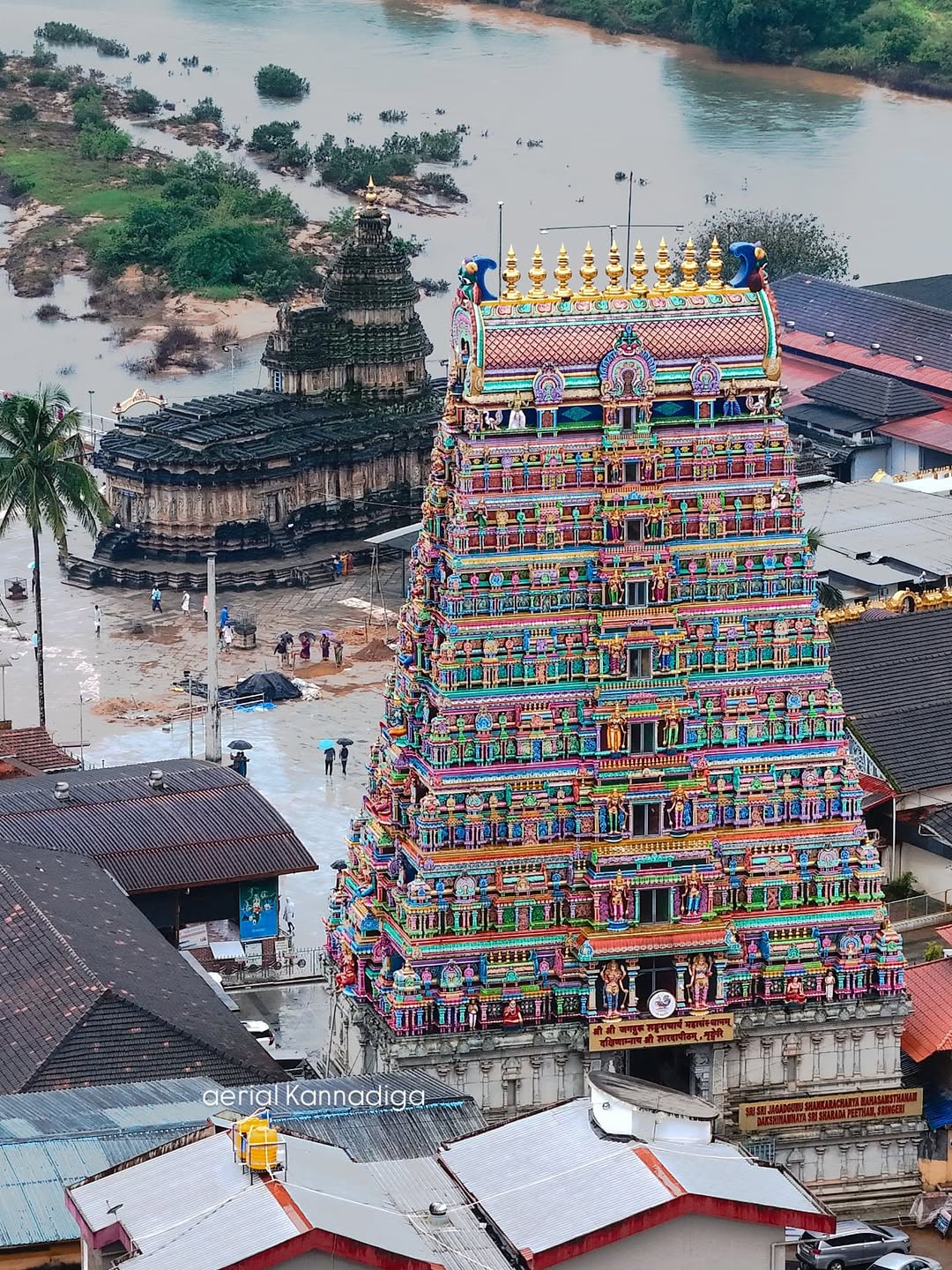
Sringeri, Karnataka
Sringeri Sharada Peetham
Also known as: Dakshinamnaya Peetham, Sringeri Matha, Sharadamba Temple
The first and foremost of the four original mathas established by the great theologian Adi Shankaracharya, serving as a supreme center for Advaita Vedanta, Vedic learning, and the worship of Goddess Sharada (Saraswati).
The History
According to tradition, while traveling across the country, Shankara reached the serene banks of the Tunga River. Here, he witnessed an astonishing sight: a hooded cobra providing shade to a spawning frog to protect it from the scorching sun. Deeply moved by this profound display of natural enmity being transcended by compassion, he realized that this land was a sacred place of absolute peace and chose it to establish his first Peetham.
Historically, the Peetham gained immense political and spiritual prominence during the 14th century. The 12th Jagadguru of Sringeri, Sri Vidyaranya, played a pivotal role in guiding Harihara and Bukka to establish the mighty Vijayanagara Empire, which stood as a bulwark for Hindu culture in South India.
The Peetham has an unbroken lineage of illustrious Gurus (Jagadgurus) from Adi Shankara to the present day, maintaining its legacy as a supreme seat of spiritual learning and philosophical discourse.
Sacred Architecture
Dravidian and Vidyashankara Marvels
The Sringeri matha complex houses two magnificent and distinct primary temples. The main Sharadamba Temple is built in the traditional Dravidian style. Originally a modest wooden structure housing the sandalwood idol, it was rebuilt in stone in the early 20th century by the 33rd Jagadguru, and the current golden idol of the Goddess was installed.
Adjacent to it stands the breathtaking Vidyashankara Temple, built in the 14th century with the patronage of the Vijayanagara kings. This temple is an architectural masterpiece that seamlessly blends Hoysala, Chalukya, and Vijayanagara styles. It is built entirely of intricately carved stone and is laid out on a raised plinth.
The most astounding feature of the Vidyashankara temple is its twelve sculptured pillars known as the Rashistambhas (Zodiac Pillars). Each pillar is marked by one of the twelve zodiac signs. The temple is an astronomical marvel; it is designed so that the rays of the early morning sun fall directly on the specific pillar corresponding to the current solar month.
Legend of the Deity
After Shankara emerged victorious, Mandana Mishra became his disciple. Shankara then requested Goddess Saraswati to accompany him to the south. She agreed on one strict condition: she would follow him invisibly, guided only by the sound of her anklets, but if he looked back, she would halt her journey permanently at that exact spot.
When they reached the sands of the Tunga River at Sringeri, her feet got stuck in the sand, and the sound of her anklets ceased. Concerned, Shankara looked back. True to her word, the Goddess stopped there. Shankara then consecrated a sandalwood idol of Goddess Sharada over a mystical Sri Chakra carved on a rock, invoking her eternal presence as the presiding deity of knowledge and wisdom.
Worship & Rituals
A unique and profoundly spiritual aspect of worship here is the personal daily Puja performed by the reigning Jagadguru. Twice a day, the Jagadguru performs a meticulous and elaborate worship of the Sri Chakra and a pure spatika (crystal) linga of Lord Chandramoulishwara, which was handed down to Adi Shankaracharya by Lord Shiva himself at Kailash.
Devotion at Sringeri extends beyond the temple walls to the Tunga River. Feeding the large, sacred fish in the river at the temple steps is considered a highly meritorious act by visiting pilgrims. Additionally, true to its nature as a seat of learning, Vidyadana (the imparting of free Vedic and Sanskrit education) is considered one of the highest forms of worship here, sustained by the Peetham's extensive gurukulas.
Festivals
Shankara Jayanti, a five-day festival in April/May celebrating the birth of Adi Shankaracharya, is observed with immense devotion, featuring continuous chanting of the four Vedas, Upanishads, and the philosopher's literary works.
Vyasa Puja is another highly significant event marking the beginning of Chaturmasya, a four-month period during the monsoon when the ascetic Jagadgurus stay in one place, dedicating their time entirely to deep meditation, philosophical discourses, and teaching.
⏳ Daily Schedule
08:00 AM - 09:00 AM: Morning Puja
10:00 AM - 12:00 PM: Chandramoulishwara Puja (by Jagadguru)
04:00 PM - 09:00 PM: Evening Darshan
07:00 PM - 08:30 PM: Evening Puja & Mangalarti
08:30 PM - 10:00 PM: Night Chandramoulishwara Puja (by Jagadguru)
Associated Shrines
Vidyashankara Temple
Dedicated to the 10th Jagadguru, Sri Vidyashankara Tirtha
An architectural marvel located right next to the Sharadamba temple, combining Hoysala and Dravidian styles
Malahanikareshwara Temple
Form of Lord Shiva
An ancient temple located on a hillock in the center of Sringeri; historically worshipped by Sage Bhavamanyar
Torana Ganapati Temple
Form of Lord Ganesha
A highly revered shrine where devotees pray for the successful completion of their endeavors
Sri Rishyasringa Temple (Kigga)
Sage Rishyasringa
Located a few kilometers from Sringeri; dedicated to the sage who performed the Putrakameshti Yagna for King Dasharatha in the Ramayana