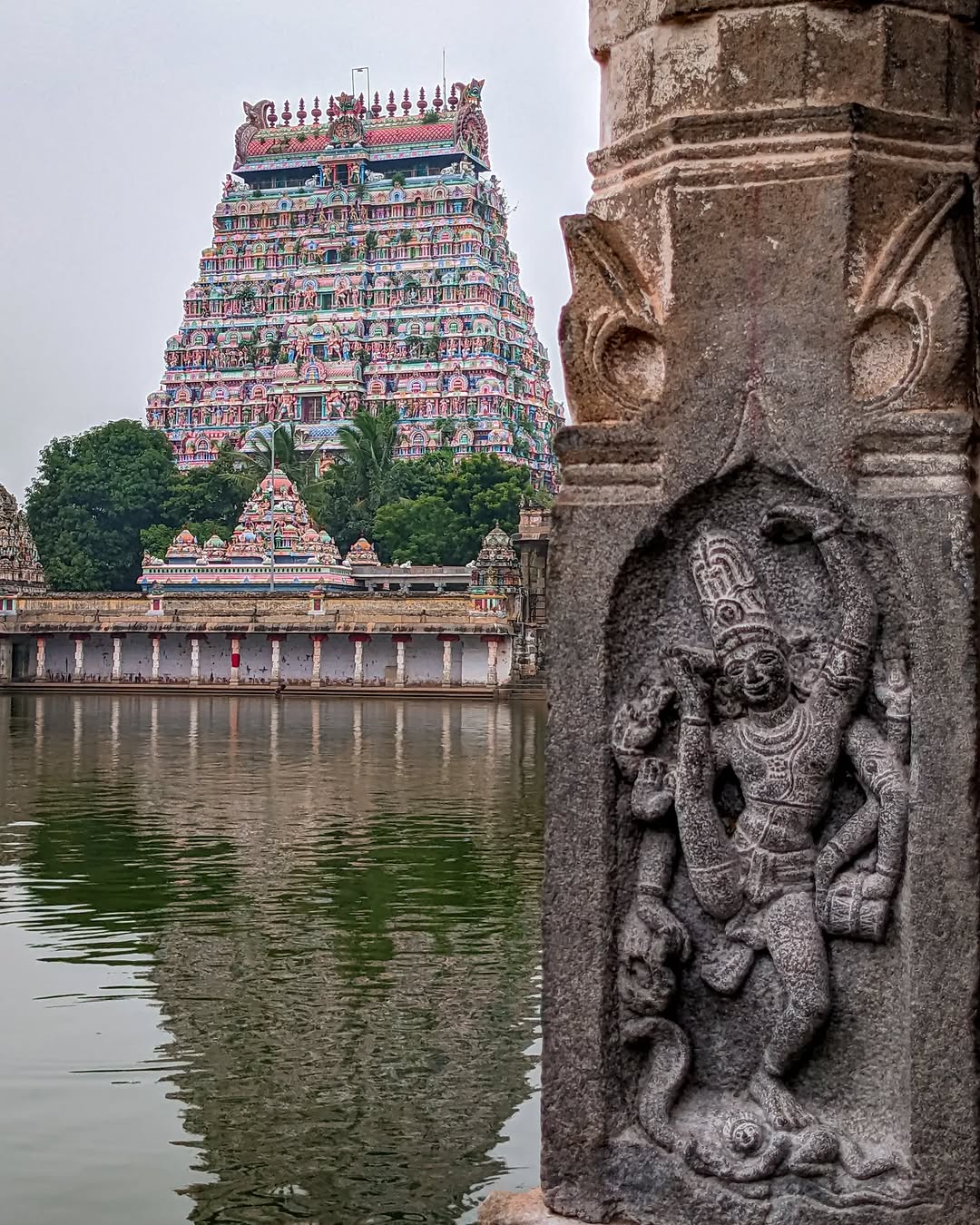
Chidambaram, Cuddalore District, Tamil Nadu, India
Chidambaram Temple
Also known as: Thillai Nataraja Temple, Thillai Natarajar Kovil
ShaivismPancha Bhoota StalamDravidian ArchitecturePilgrimageAkasha LingamChidambara RahasyamAnanda TandavaPodhu DikshitarsGolden Roof
The Thillai Nataraja Temple is the foremost of all Shaivite shrines (often referred to simply as 'Kovil' by Shaivites). It represents the 'Akasha' (Space or Ether) element of the Pancha Bhoota Stalams. It is uniquely famous because the presiding deity is not worshipped as a traditional Shiva Lingam, but as Nataraja—the Lord of Dance—frozen mid-movement in the breathtaking Ananda Tandava (Dance of Bliss).
Primary DeityLord Nataraja (Shiva)Form of Cosmic Dancer (Ananda Tandava) / Akasha Lingam (Space)
TraditionHinduism (Shaivism)
AdministrationThe Podhu Dikshitars
Historical ManagementUnlike most major temples in Tamil Nadu which are controlled by the government (HR&CE), Chidambaram is uniquely owned and independently managed by the 'Podhu Dikshitars', an ancient, endogamous community of Smartha Shaivite Brahmins who have served as the temple's hereditary priests for millennia. Supreme Court rulings have legally protected their exclusive right to manage the temple.
The History
The temple's antiquity is legendary. While the current monumental stone structures were largely built and patronized by the grand Chola dynasty (with later additions by Pandyas, Pallavas, and Vijayanagara kings), the shrine existed long before. The Chola kings were so devoted to Nataraja that they covered the roof of the main sanctum (Chit Sabha) with solid gold, a feature that still gleams today.
Sacred Architecture
The Anatomy of the Universe
The temple complex is massive, spanning 40 acres, and represents the human body. The sanctum (Chit Sabha) is situated slightly off-center, representing the human heart. The golden roof of the Chit Sabha is held up by 22,600 golden tiles representing the number of breaths a human takes in a day, fixed with 72,000 golden nails representing the 'nadis' (energy channels) of the human body. The magnificent outer Gopurams are famous for being carved with the complete 108 Karanas (dance postures) of the Natya Shastra.Legend of the Deity
According to lore, Lord Shiva strolled into the Thillai (mangrove) forest to confront a group of arrogant sages who believed magic and rituals were superior to God. To crush their ignorance, Shiva performed the Ananda Tandava. He danced upon the demon 'Apasmara' (who represents ignorance) and revealed his true cosmic form to his ardent devotees, the sages Patanjali (who is depicted with a snake body) and Vyaghrapada (depicted with tiger claws).
Worship & Rituals
Worship is conducted according to a unique Vedic ritual manual specific only to the Dikshitars, differing greatly from the Agamic rituals of other South Indian temples. A fascinating aspect is the presence of the Lord Govindaraja Perumal (Vishnu) shrine right next to Nataraja, allowing devotees to view both Shiva and Vishnu from a single vantage point—a powerful symbol of unity.
The ultimate spiritual draw of the temple is the Chidambara Rahasyam (The Secret of Chidambaram). To the right of Lord Nataraja in the sanctum is a curtain. During specific poojas, the priests draw back this curtain. Behind it, there is no idol, but an empty space adorned with golden Bilva leaves. This signifies that the ultimate, truest form of God is formless, infinite space (Akasha). The 'secret' is realizing that God exists in the empty space of one's own heart.
The ultimate spiritual draw of the temple is the Chidambara Rahasyam (The Secret of Chidambaram). To the right of Lord Nataraja in the sanctum is a curtain. During specific poojas, the priests draw back this curtain. Behind it, there is no idol, but an empty space adorned with golden Bilva leaves. This signifies that the ultimate, truest form of God is formless, infinite space (Akasha). The 'secret' is realizing that God exists in the empty space of one's own heart.
Festivals
The two largest festivals are Marghazhi Thiruvaadhirai (December-January) and Aani Thirumanjanam (June-July). These are the only two times in the entire year when the main bronze idol of Lord Nataraja is brought out of the sanctum for a massive public procession and a grand Abhishekam.
⏳ Daily Schedule
Visiting Hours: Daily from 6:00 AM to 12:00 PM, and 5:00 PM to 10:00 PM.
(Note: The temple experiences brief closures during the day for the priests to perform the six distinct, elaborate daily Kalasanthi and Sayarakshai poojas.)
(Note: The temple experiences brief closures during the day for the priests to perform the six distinct, elaborate daily Kalasanthi and Sayarakshai poojas.)
Continue Journey
Associated Shrines
Arunachalesvara Temple, Tiruvannamalai
Pancha Bhoota Stalam
The Fire (Agni) element temple in the grand elemental circuit of South India.
Jambukeswarar Temple, Thiruvanaikaval
Pancha Bhoota Stalam
The Water (Appu) element temple in the circuit.