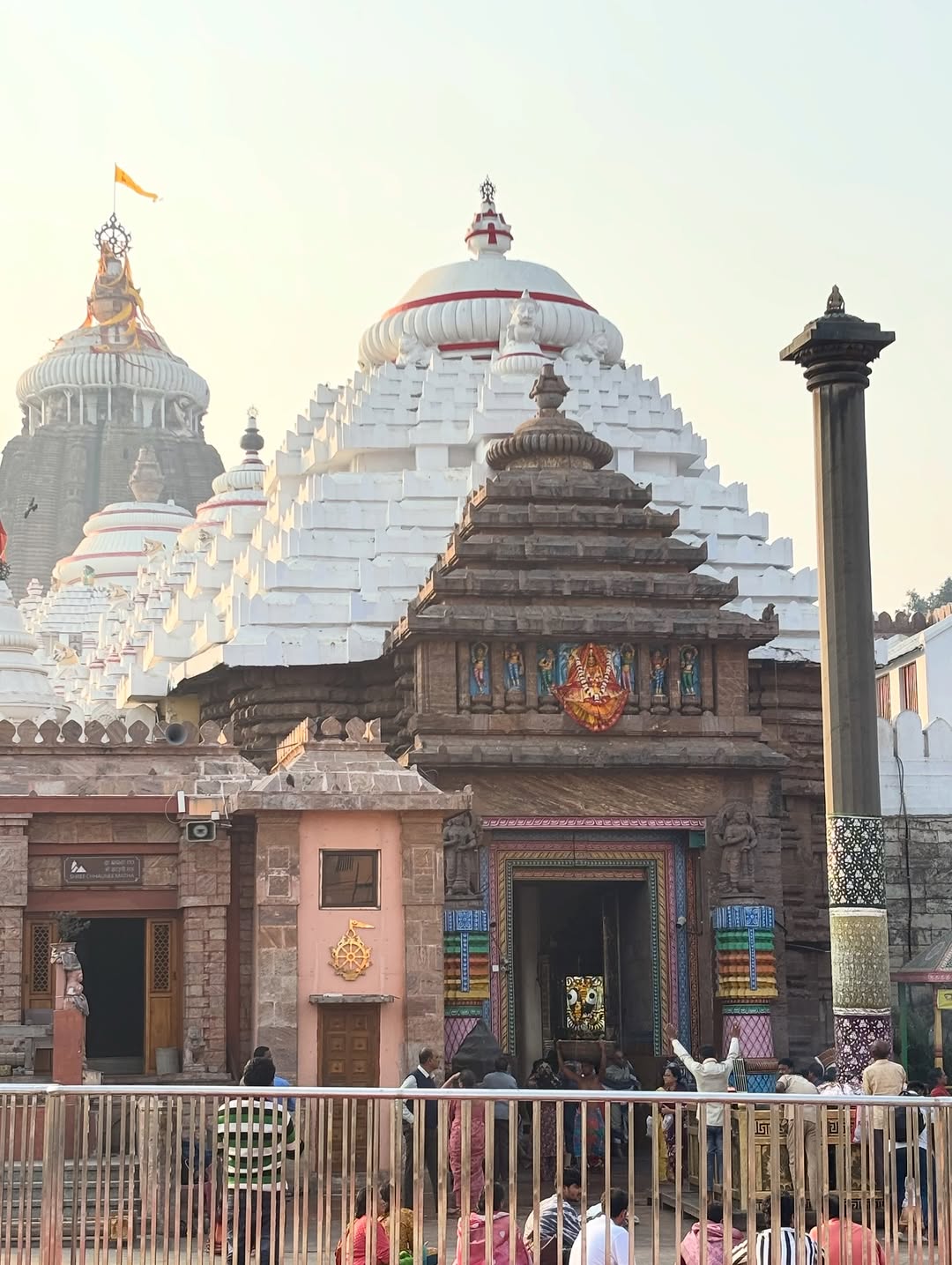
Puri, Odisha
Jagannath Temple
Also known as: Puri Jagannath, Shree Mandira, Badadeula
One of the sacred Char Dham pilgrimage sites, famous for its grand annual Ratha Yatra, the mystical 22 steps (Baisi Pahacha), and the deeply revered Mahaprasad cooked in the world's largest traditional kitchen.
The History
The current temple structure was initiated in the 12th century by King Anantavarman Chodaganga Deva, the first of the Eastern Ganga dynasty. It was later completed by his descendant, King Anangabhima Deva III. The temple has played a central role in the cultural, social, and religious history of Odisha, heavily influencing the region's traditions and art forms.
Throughout its history, the temple faced numerous invasions and attacks. To protect the deities during these turbulent times, the priests often secretly transported and hid the wooden idols in remote caves and forests. Despite these disruptions, the devotion to Lord Jagannath remained an unbreakable unifying force for the people.
Sacred Architecture
Kalinga Architecture and Engineering Mysteries
The Jagannath Temple is a spectacular masterpiece of Kalinga architecture. The main tower (Vimana) rises majestically to a height of 214 feet, topped with the sacred Neela Chakra (Blue Wheel). This 20-foot-tall Sudarshan Chakra is crafted from Ashtadhatu (an alloy of eight metals). An extraordinary architectural feat of the Neela Chakra is its front-facing illusion: no matter where you stand in the city of Puri, the immovable wheel always appears to face you directly. Revered as the 'divine eye' of the Lord, seeing the Chakra is traditionally considered just as auspicious as taking darshan of the deity itself.
The temple is also famous for phenomena that blur the line between spiritual mystery and advanced 12th-century engineering. For instance, no birds ever fly over the main dome. Furthermore, the temple flag (Patitapabana Bana) remarkably always flutters in the opposite direction of the wind. While celebrated as a divine miracle, this is actually a brilliant demonstration of complex aerodynamics. The massive, solid structure of the Shikhara acts as a 'blunt body' blocking the coastal sea breeze, creating swirling 'vortex street' currents and localized pressure differences that force the airflow immediately around the spire to move against the primary wind.
At the main Eastern entrance (Simhadwara / Lion's Gate) lies the sacred Baisi Pahacha (22 Steps). These steps symbolize the journey to spiritual liberation, representing the shedding of 22 types of sins. The third step holds the Yama Shila (Yama's stone). Devotees observe strict rituals here: stepping on the Yama Shila while *entering* cleanses one's sins, but stepping on it while *exiting* is believed to destroy accumulated spiritual merits. Because of this, devotees often exit through a different gate.
Legend of the Deity
However, the temple is not just a relic of ancient mythology; it is a living epicenter of modern faith and divine intervention. In a widely documented and deeply emotional incident in November 2025, a heartbroken father—who had reportedly traveled from outside Odisha directly from a hospital—carried his comatose, severely ill son to the Singhadwara (Lion's Gate). Overcome with tears, he pleaded, 'You are our last hope.' Miraculously, as prayers echoed through the courtyard, the boy stirred, opened his eyes, and whispered, 'Bapa!' (Father), effectively waking from his coma. The viral scene left witnesses in tears and the crowd roaring 'Jai Jagannath!', reinforcing the immense faith devotees place in the Lord's ultimate healing grace.
Worship & Rituals
One of the most breathtaking acts of daily devotion is the Dhwaja Parivartan (Chunara Seva). In an unbroken 1,800-year-old tradition, every day before sunset, a specially designated priest from the Chunara community climbs the massive 214-foot Shikhara (spire) entirely barehanded, without any ropes or safety gear. Shouting 'Jai Jagannath!', he reaches the top to remove the old flag and tie the new Patitapabana Bana to the Neela Chakra. According to strict temple law, if this terrifyingly high and sacred ritual is missed for even a single day, the temple must be shut down for 18 years.
The absolute pinnacle of the temple's culinary tradition is the Mahaprasad (Chappan Bhog), consisting of 56 daily dishes. It is cooked in the world's largest traditional kitchen, utilizing 752 clay stoves (chulhas) and roughly 15,000 earthen pots daily. The cooking method defies modern logic: earthen pots are stacked in pyramids of up to nine pots over a wood-burning fire, yet miraculously, the food in the topmost pot cooks first!
The Mahaprasad is strictly vegetarian and is divided into two types: Sankudi (wet items cooked with water like Kanika/sweet rice, Dalma, and Mahura) and Sukhila (dry items and sweets like Khaja and Rasagulla). After being offered to Lord Jagannath and then to Goddess Vimala, devotees consume this sacred food exclusively on banana leaves in the Ananda Bazar. Here, all societal distinctions vanish, as people of all backgrounds sit and eat together in ultimate equality.
Festivals
The prelude to the Ratha Yatra is deeply traditional. On Jyeshtha Purnima, the deities are bathed with 108 pots of sacred water (Snana Yatra). Following this grand bath, the deities supposedly fall 'feverish' for 15 days in a private healing period known as Anasara, during which they are treated with herbal medicines and kept out of public view.
Another highly secretive festival is the Nabakalebara ('New Body'). Taking place every 12 to 19 years, the ancient wooden deities are ceremoniously buried, and new wooden idols are carved from specially identified Neem trees possessing specific divine marks.
⏳ Daily Schedule
06:00 AM - 08:00 AM: Abakasha & Besha
08:00 AM - 09:00 AM: Gopalaballabha Puja
09:00 AM - 11:00 AM: Sakala Dhupa (Morning Offering)
11:00 AM - 01:00 PM: General Darshan
01:00 PM - 02:30 PM: Madhyahna Dhupa (Midday Offering)
06:00 PM - 07:00 PM: Sandhya Alati
08:00 PM - 09:30 PM: Sandhya Dhupa
10:30 PM - 11:30 PM: Badasinghara Besha
12:00 AM: Pahada (Temple Closes)
Associated Shrines
Gundicha Temple
Aunt of Lord Jagannath
The destination of the annual Ratha Yatra; the deities stay here for 7 to 9 days
Vimala Temple
Shakti Peetha (Goddess Vimala)
Located within the Jagannath temple complex; food offered to Jagannath becomes Mahaprasad only after being offered to Goddess Vimala
Alarnath Temple
Form of Lord Vishnu
Located in Brahmagiri; heavily visited during 'Anasara' when Lord Jagannath falls sick and is kept out of public view
Sakshigopal Temple
Form of Lord Krishna
It is traditionally believed that a pilgrimage to Puri is incomplete without visiting Sakshigopal