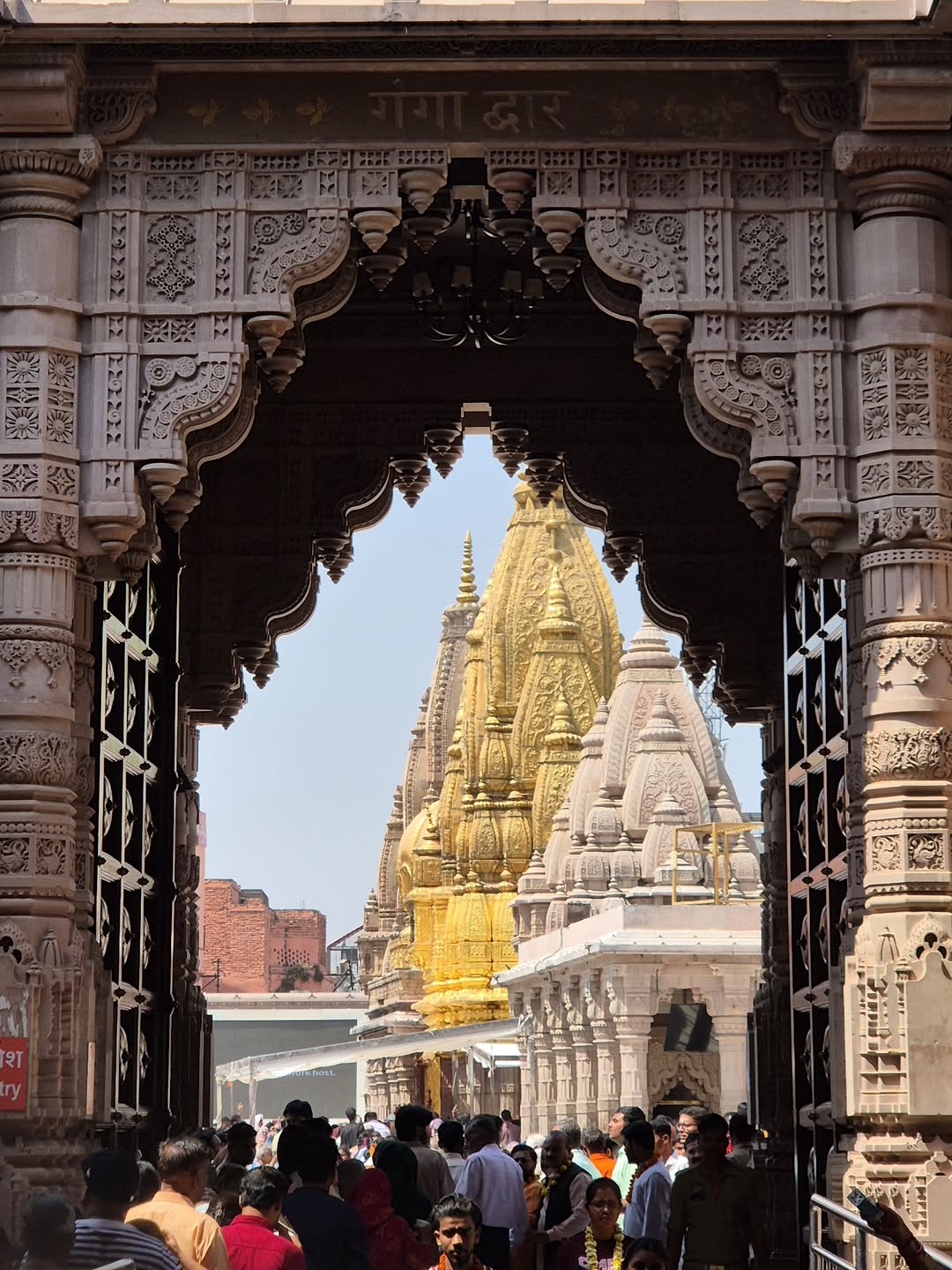
Varanasi | Kashi | Banaras, Uttar Pradesh
Shri Kashi Vishwanath Temple
Also known as: Golden Temple of Varanasi, Vishweshwara Temple, Kashi Vishwanath Mandir
Kāśi, the 'City of Light,' is the spiritual capital of India. Founded by Lord Shiva himself, the city is an ancient, living mandala where divine energy flows eternally. At its heart lies the Kashi Vishwanath Temple. For centuries, devotees have journeyed to its sacred ghats and labyrinthine lanes seeking purification, knowing that dying in Kashi offers a direct path to Moksha (ultimate liberation).
The History
In 1669 CE, Mughal emperor Aurangzeb ordered the demolition of the Kashi Vishwanath Temple. As a matter of documented historical fact, the Gyanvapi Mosque was constructed directly over its ruins. The name Gyanvapi translates to 'Well of Knowledge,' referring to the sacred well within the complex where devotees believe the original Shiva Lingam was hidden. The western wall of the mosque still prominently displays the intricate stone carvings of the original Hindu temple, and recent archaeological surveys have documented significant structural evidence of Hindu motifs within the mosque area.
The present temple was built in 1780 by Queen Ahilyabai Holkar of Indore. Today, the temple remains one of the twelve Jyotirlingas, symbolizing the eternal and infinite nature of Lord Shiva, and continues to be the central pillar of spiritual life in India.
Sacred Architecture
The Cosmic Mandala and the Trishul
The sacred geography of Kashi is an astonishing marvel of ancient spiritual engineering. According to the Kashi Khanda, the entire city does not rest on the earth, but rather stands balanced upon the three prongs of Lord Shiva's Trishul (trident). The three main temples forming this fulcrum are Omkareshwara in the north, Vishweshwara (Kashi Vishwanath) in the middle, and Kedareshwara in the south. Each temple creates its own 'Khanda' or sphere of influence.Radiating outward from this center is a highly complex Cosmic Mandala. Protecting the city in the 8 cardinal directions are the Ashta Bhairavas (Unmatta, Krodhana, Kapala, Asitanga, Canda, Ruru, Bhisana, and Samhara). Within this protective grid, exactly 56 Ganesha temples are established in 7 concentric circles. A pilgrim's walk to visit these 56 shrines creates a natural, clockwise spiritual spiral that inevitably draws them to the absolute center: the Kashi Vishwanath Temple. Additionally, the grid contains 64 Yogini temples, 12 Sun temples, 9 Navadurgas, and 9 Chandi temples, forming the 468 major shrines of the city.
At the center of this geometric marvel sits the Vishwanath temple itself, built in the traditional Nagara architectural style, famous for its three domes plated in pure gold by Maharaja Ranjit Singh. A profound historical reality of the site is the placement of the large ancient statue of Nandi. While Hindu architecture mandates Nandi face the Shiva Lingam, this ancient Nandi does not face the current sanctum. Instead, it looks directly at the boundary wall of the Gyanvapi Mosque, eternally waiting and guarding the exact location of the original, ancient Garbhagriha that was destroyed in 1669.
Legend of the Deity
As described in sacred texts, a dispute arose between Brahma and Vishnu over their supremacy. Shiva appeared as a vast, radiant pillar of light stretching endlessly in all directions. When neither Brahma nor Vishnu could find its beginning or end, it established the supremacy of Shiva as the infinite reality beyond creation and preservation. The Jyotirlinga represents the axis of existence.
Devotees believe that Lord Shiva resides permanently in Kashi, and at the moment of death, he grants liberation (Moksha) by guiding the soul with the sacred Taraka mantra. Over centuries, Kāśi has been a hub for learning, philosophy, music, and literature, producing great scholars like Adi Shankaracharya and Tulsidas. Even today, its narrow lanes echo with the sounds of chants, making Kāśi a living symbol of timeless devotion, death, rebirth, and ultimate liberation.
Worship & Rituals
One of the most unique rituals is the Saptarishi Aarti held in the evening. During this profound ceremony, seven prominent priests (representing the seven great sages) simultaneously perform the aarti to the Lord, accompanied by the powerful rhythmic chanting of ancient Vedic mantras and the beating of damarus.
Festivals
The holy month of Shravan (July-August) sees millions of Kanwariyas travel barefoot to offer sacred Ganges water to the Jyotirlinga.
Dev Deepawali, celebrated fifteen days after Diwali, is mesmerizing. The ghats of Kashi and the temple are illuminated with millions of earthen lamps (diyas), honoring the descent of the gods to Earth.
⏳ Daily Schedule
04:00 AM - 11:00 AM: General Darshan
11:15 AM - 12:20 PM: Bhoga / Midday Aarti
12:00 PM - 07:00 PM: General Darshan
07:00 PM - 08:15 PM: Saptarishi Aarti
After 08:30 PM: General Darshan
10:30 PM - 11:00 PM: Shayan Aarti
Associated Shrines
Omkareshwar Mahadev & Gauri Kedareshwar
The Points of the Trishul
Together with Vishweshwara, these temples form the three points of Shiva's cosmic trident upon which the city stands.
The 8 Kala Bhairava Temples
Guardians of the Mandala
Unmatta, Krodhana, Kapala, Asitanga, Canda, Ruru, Bhisana, and Samhara Bhairava protect the 8 cardinal directions of Kashi.
The 56 Ganesha Shrines
The Spiritual Spiral
Arranged in 7 concentric circles, creating a natural clockwise walk of devotion that leads pilgrims directly to the center: Kashi Vishwanath.