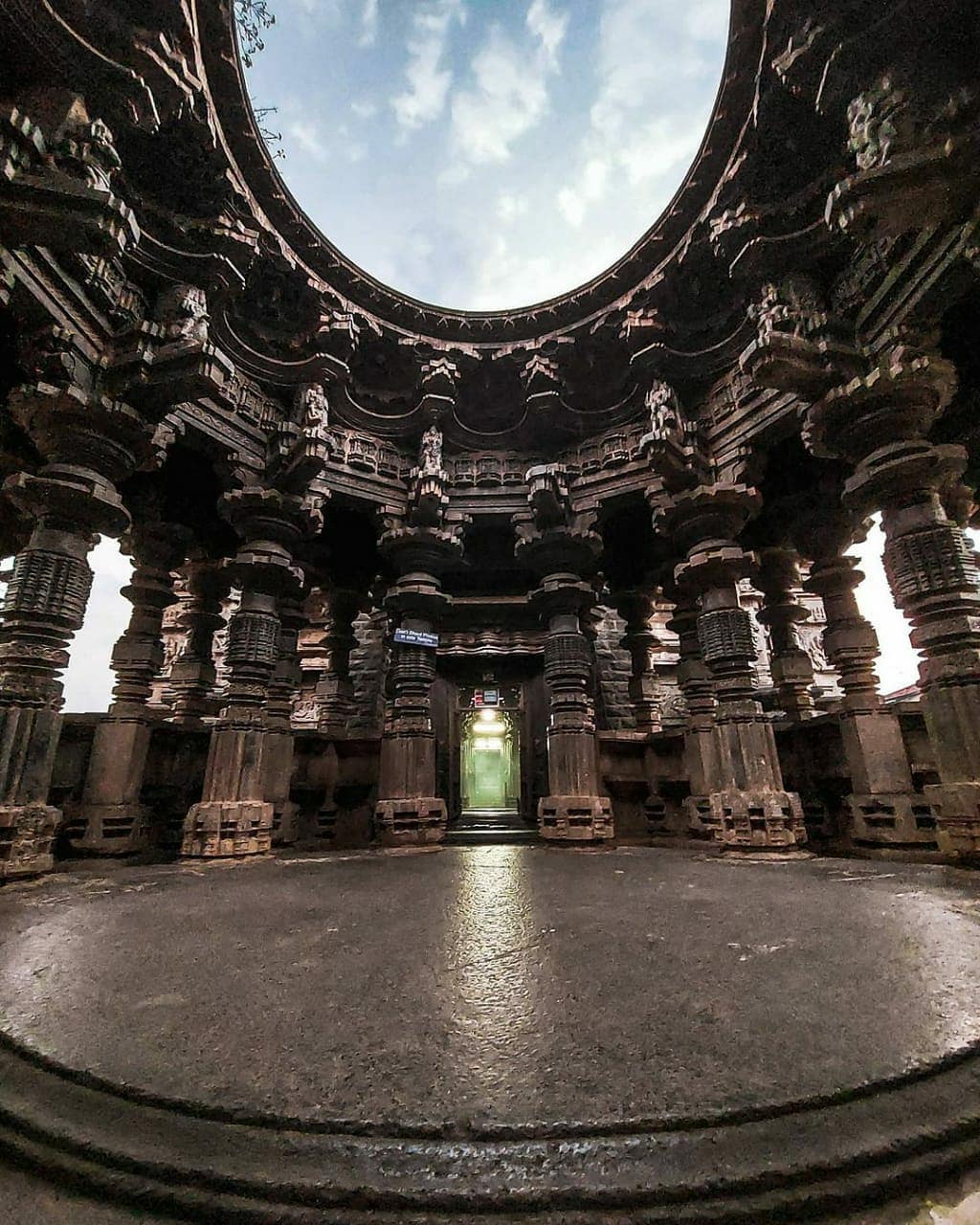
Khidrapur, Kolhapur District, Maharashtra, India
Kopeshwar Temple
Also known as: Kopeshwar Mandir, Khidrapur Shiva Temple
Nestled on the banks of the Krishna River at the border of Maharashtra and Karnataka, the Kopeshwar Temple is a breathtaking 12th-century architectural marvel. Famous for its mesmerizing open-to-sky 'Swarga Mandap' and the striking absence of Lord Shiva's trusted mount, Nandi, the temple is an exquisite blend of profound mythology and unparalleled stone craftsmanship.
The History
Sacred Architecture
The Heavenly Hall and the Elephant Base
The temple is an outstanding example of the Chalukyan / Hemadpanthi style of architecture, constructed from high-quality basalt stone. The complex is divided into four interconnected parts: the Swarga Mandap, Sabha Mandap, Antarala, and the Garbhagriha (Sanctum).The Swarga Mandap (Heavenly Hall): The most iconic feature of the temple. It is a detached, circular pavilion with a completely open roof (an oculus) directly exposing the center of the hall to the sky. It is supported by 48 exquisitely carved, circular stone pillars. During special astrological alignments, sunlight or moonlight pours directly through the oculus, bathing the center stone in a celestial glow.
The Gaja Peetha (Elephant Base): The entire temple structure rests on the backs of 92 massive, intricately carved stone elephants. Each elephant is distinct, adorned with different ornaments, and carved alongside various deities riding them, creating an illusion that a herd of divine elephants is carrying the temple into the heavens.
Legend of the Deity
The Missing Nandi: In almost every Shiva temple worldwide, Nandi the bull faces the Lingam. Uniquely, there is no statue of Nandi in the Kopeshwar temple complex. Legend states that Nandi had traveled with Sati to her father's yagna and was not present with Shiva when he arrived at Khidrapur in his enraged state. (There is a separate Nandi temple situated miles away in Yadur, Karnataka, which locals believe faces this temple).
Worship & Rituals
Festivals
⏳ Daily Schedule
Associated Shrines
Mahalakshmi Temple, Kolhapur
The Shakti Hub
Located roughly 60 km away, this is one of the 18 Maha Shakti Peethas. Pilgrims often combine a visit to the powerful Mother Goddess with a trip to Kopeshwar.
Shri Dattatreya Temple, Narsobawadi
Confluence Shrine
A highly revered pilgrimage site located at the confluence of the Panchganga and Krishna rivers, located close to Khidrapur.
Veerabhadra Temple, Yadur
The Distant Nandi
Located across the river in Karnataka, locals believe the Nandi idol here is the actual mount of the Kopeshwar Shiva, separated by distance due to the mythological events.