Siem Reap, Siem Reap Province, Cambodia
Angkor Wat
Also known as: Nokor Wat, Parama Vishnuloka, City of Temples
Angkor Wat is the ultimate architectural expression of the Khmer Empire and the largest religious monument on Earth. Originally dedicated to Lord Vishnu and later transformed into a Buddhist sanctuary, it is a literal 'Heaven on Earth'—a massive stone representation of the Hindu cosmos, surrounded by a vast moat that mirrors the cosmic ocean.
The History
Sacred Architecture
The Stone Mandala
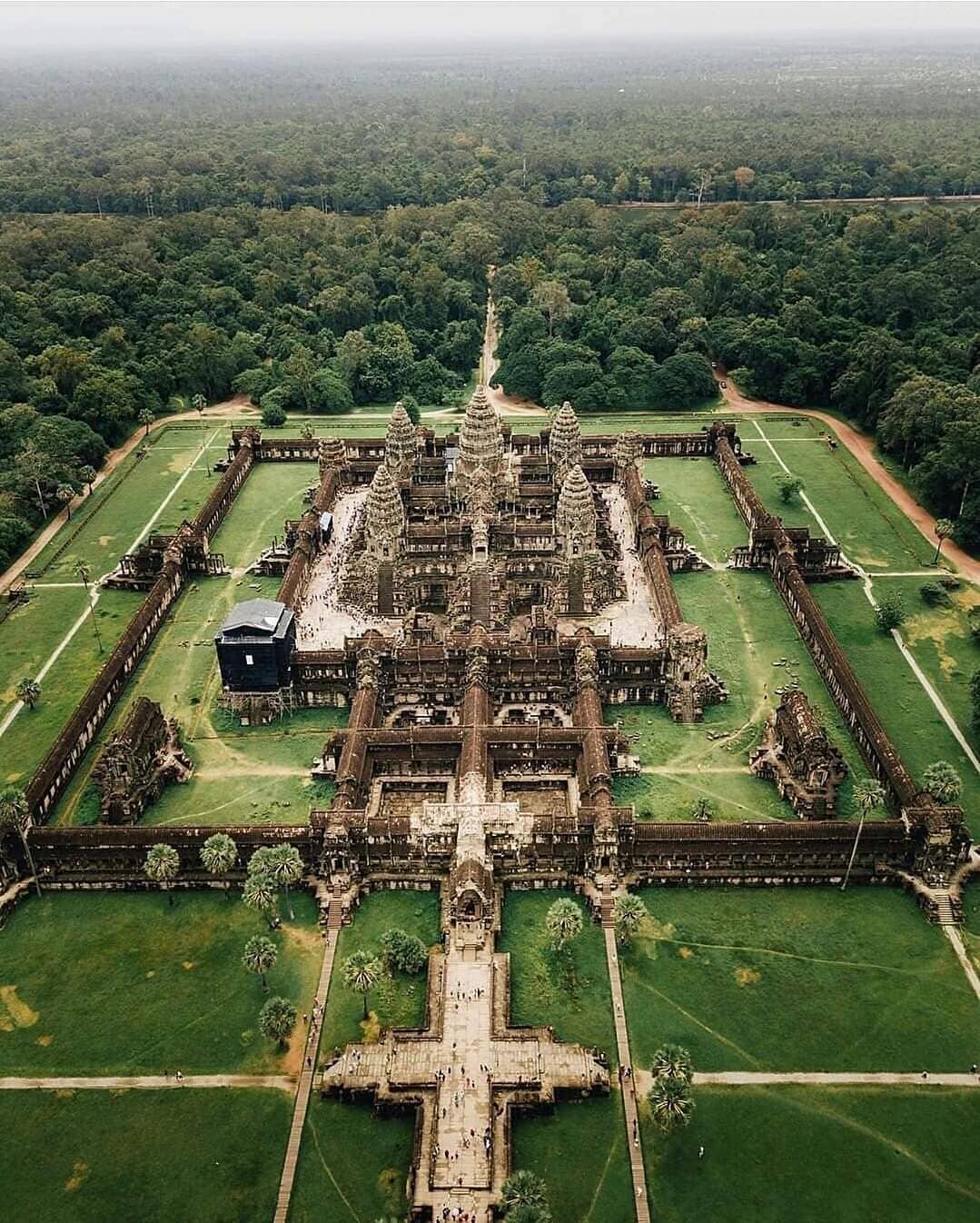
Angkor Wat is the pinnacle of Khmer classical architecture, known as the Angkor Wat style. It is a 'temple-mountain' combined with the later plan of concentric galleries. The design is characterized by its Quincunx arrangement—five towers shaped like lotus buds rising from a central platform.The entire complex is surrounded by a 190-meter wide moat and an outer wall 3.6 kilometers long. Every surface of the sandstone galleries is covered in intricate carvings, including nearly 2,000 Apsaras (celestial dancers), each unique in hair and posture. The precision of the sandstone blocks, fitted together without mortar, remains a testament to the sophisticated engineering of the Khmer Empire.
Ancient Hydro-Engineering
The temple's survival is largely due to its miraculous water management system. It is surrounded by a 190-meter-wide moat that stretches over 5 kilometers. This moat wasn't just for defense or cosmological symbolism (representing the cosmic ocean); it acts as a crucial stabilizing mechanism. The massive body of water prevents the heavy sandstone monument from sinking into the earth by regulating the groundwater levels through wet and dry seasons—a feat of ancient engineering so massive it is visible from space.Legend of the Deity
The galleries contain the world's longest continuous bas-reliefs, most notably the Churning of the Ocean of Milk (Samudra Manthana). In this legend, 88 Asuras and 92 Devas use the serpent Vasuki to churn the ocean to obtain Amrita (the nectar of immortality), with Lord Vishnu appearing in the center as his turtle avatar, Kurma, to support the mountain as a pivot point.
Worship & Rituals
Festivals
⏳ Daily Schedule
(Note: Witnessing the sunrise behind the lotus-bud towers is considered a transformative spiritual experience for many travelers.)
Associated Shrines
Angkor Thom / Bayon
The Great City
The last capital of the Khmer Empire, famous for the Bayon temple with its serene stone faces, located just north of Angkor Wat.
Ta Prohm
The Jungle Temple
Left largely as it was found, with massive tree roots entwined with the ruins, showcasing the raw power of nature over human architecture.
Banteay Srei
The Jewel of Khmer Art
A 10th-century temple dedicated to Shiva, known for its intricate, miniature carvings in pink sandstone.