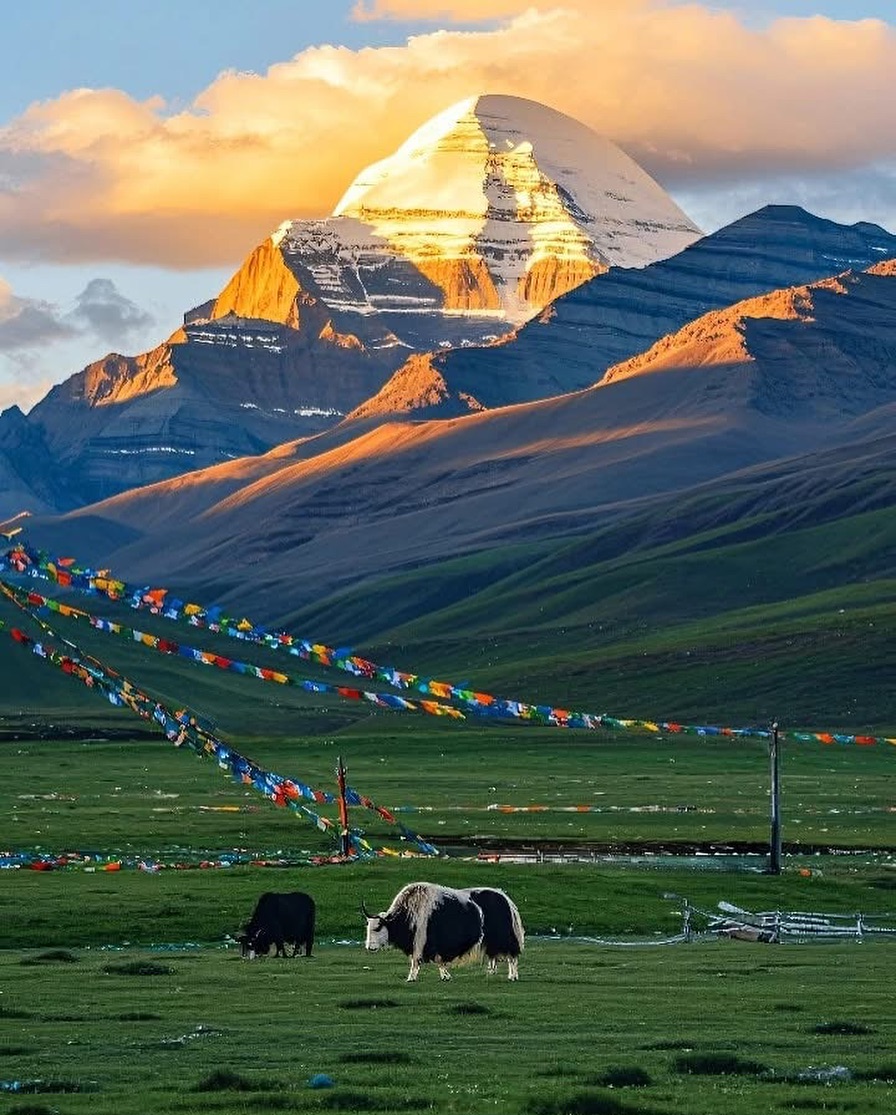
Ngari Prefecture (Transhimalaya), Tibet Autonomous Region, China
Mount Kailash (Kailasa Parvat)
Also known as: Kangrinboqe Peak, Gang Rinpoche, Gang Tise, Mount Meru, Ashtapada
Standing at 6,638 m (21,778 feet) in the remote, freezing expanse of the Tibetan Himalayas, Mount Kailash is not merely a mountain; it is the ultimate spiritual epicenter of the universe. Revered by billions across four major religions, this massive, unclimbed pyramid of black rock is the eternal, physical abode of Lord Shiva and Goddess Parvati. Known as the 'Snow Jewel Mountain,' it is a place of absolute, terrifying cosmic stillness and serves as the primary peak of the sacred Pancha Kailash.
The History
The mountain remains one of the only major peaks in the world that is completely unclimbed. Out of deep respect for its absolute sanctity, it is strictly forbidden for anyone to set foot on its slopes. Early mountaineers like Hugh Ruttledge and Herbert Tichy surveyed it but did not conquer it. In the 1980s, legendary climber Reinhold Messner declined an offer to climb it, stating, 'If we conquer this mountain, then we conquer something in people's souls.' To date, there is no recorded successful ascent.
Sacred Architecture
The Cosmic Pyramid
The 'architecture' of Kailash is purely natural, yet it possesses a geometry so perfect it defies geology. The mountain is a massive, towering four-sided pyramid of black rock, with each face perfectly aligning with the four cardinal directions (North, South, East, West).Its southern face is distinguished by a massive vertical cleft intersected by a horizontal layer of rock, naturally forming the eternal symbol of the Swastika when the evening sun hits the snow. The mountain complex acts as the source of four of Asia's greatest rivers: the Indus, the Sutlej, the Brahmaputra, and the Ghaghara (Karnali).
Sacred Geography of the Region
- Lake Manasarovar: The Lake of Consciousness. A massive freshwater lake (the highest in the world) created in the mind of Lord Brahma. Bathing in its freezing waters is said to wash away the sins of a hundred lifetimes.
- Rakshastal: The Lake of Demons. A dark, crescent-shaped saltwater lake where Ravana performed his severe penance. Strikingly, no plant or fish life exists in it, and pilgrims strictly avoid bathing here.
- Gauri Kund: The Goddess's Pool. An intensely emerald-green glacial lake located at 18,400 feet where Goddess Parvati bathed and breathed life into the dust to create Lord Ganesha.
- Yam Dwar: Gateway of the God of Death. The starting point of the Parikrama. Pilgrims must pass through this 'Gate of Yama' to symbolically leave their mortal fears behind before circling the Lord.
Legend of the Deity
The mountain is the site of the famous Ravananugraha legend. The demon king Ravana arrogantly attempted to uproot Mount Kailash. Lord Shiva simply pressed his big toe down, crushing Ravana beneath its unimaginable cosmic weight until the demon sang the Shiva Tandava Stotram for a thousand years.
Beyond Hinduism, it is revered in Jainism as Ashtapada (where the first Tirthankara, Rishabhanatha, attained Moksha). In Vajrayana Buddhism, it is the home of Buddha Demchok and the site where saint Milarepa won a magical contest of wits and speed against a Bon sorcerer. In the Tibetan Bon religion, it is the abode of the sky goddess Sipaimen.
Worship & Rituals
Devotees circumambulate the base of the entire mountain. This is a grueling 53-kilometer trek at an ultra-high altitude, crossing the perilous Drölma La Pass at 5,650 meters (18,540 feet) through freezing winds and rocky terrain. The circumambulation is made in a clockwise direction by Hindus, Buddhists, and Jains, while Bonpos walk counter-clockwise. Tibetan Buddhists sometimes perform the Kora by doing full body-length prostrations over the entire stretch, which can take weeks. Completing this circumambulation is considered the highest spiritual achievement a human can attain, believed to erase the karmic debts of an entire lifetime and grant ultimate Moksha (liberation).
Festivals
On Maha Shivaratri, while the mountain is buried under impassable winter snow, millions of Hindus across the globe mentally direct their prayers toward this specific coordinate on Earth.
⏳ Daily Schedule
(Note: Due to extreme winter weather and heavy snowfall, the region is completely inaccessible to pilgrims for the rest of the year. The pilgrimage route from India involves highly regulated border crossings at Lipu Lekh or Nathu La passes.)
Associated Shrines
Adi Kailash (Chhota Kailash)
Replica of Mt. Kailash
A 5,945m peak in Uttarakhand, India. Deeply revered as a place where Lord Shiva meditates. It features the sacred Parvati Lake and Gauri Kund at its base, and is located near Om Parvat.
Kinnaur Kailash
Winter Home of Lord Shiva
A 6,050m mountain in Himachal Pradesh, India. It features a stunning 79-foot vertical rock Shivlingam that is said to change colors throughout the day. It requires an extremely challenging, steep trek.
Manimahesh Kailash
The Jewel of Shiva
A 5,653m virgin peak in Chamba, Himachal Pradesh. Pilgrims bathe in the sacred Manimahesh Lake at its base to cleanse their sins, particularly during the Bhadon month.
Shrikhand Mahadev
Site of Divine Penance
Located in Kullu, Himachal Pradesh, this peak features a 72-foot-tall natural Shiva Linga at an altitude of 5,162m. It is accessible via one of India's most treacherous and difficult 35km pilgrimage treks.