Kanchipuram, Tamil Nadu
Sri Ekambareswarar Temple
Also known as: Ekambaranathar Temple, Prithvi Sthalam, Thirukachi Ekambaram
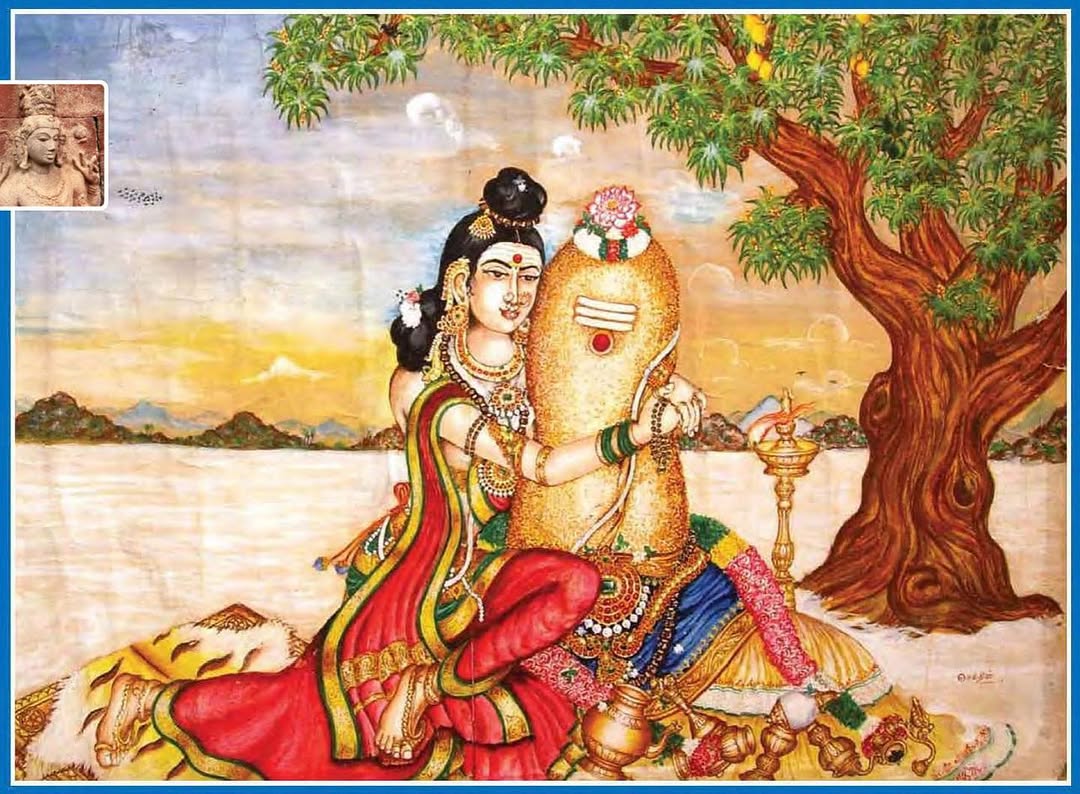
Covering a massive 23 acres in the sacred city of Kanchipuram, this spectacular temple represents the Earth Element (Prithvi) of the Pancha Bhoota Stalas. It is home to one of the most romantic and profoundly emotional legends in Hindu lore—the story of Goddess Parvati desperately embracing a fragile sand Lingam to protect it from a raging flood.
The History
The temple’s architectural evolution is a testament to the devotion of multiple great empires. The Pallavas laid the original stone foundations, the Cholas heavily expanded the courtyards, and the Vijayanagara Empire gave it its colossal scale. The towering 192-foot Raja Gopuram (one of the tallest in India) was built by the legendary Emperor Krishnadevaraya to celebrate his military conquests.
Sacred Architecture
The 192-Foot Gopuram & The Sacred Mango Tree
The temple complex is incredibly vast, featuring five spacious enclosures (Prakarams) and a spectacular 1,000-pillared hall (Aayiram Kaal Mandapam) built by the Vijayanagara kings.The 3,500-Year-Old Sthala Vriksham: In the inner courtyard stands the most famous tree in Tamil Nadu—an ancient Mango tree believed to be over 3,500 years old. Astonishingly, its four main branches yield four completely different types of mangoes, with distinct tastes, shapes, and sizes, symbolizing the Four Vedas (Rig, Yajur, Sama, and Atharva). This is the very tree under which the Goddess performed her penance.
The inner sanctum houses the Prithvi Lingam, which remains exactly as the Goddess made it—out of earth.
Legend of the Deity
Once, Goddess Parvati playfully closed Lord Shiva’s eyes, plunging the entire universe into darkness. To absolve herself of this cosmic mistake, Shiva directed her to Earth to perform severe penance. She arrived at the holy city of Kanchipuram and sat under a sacred mango tree. Using the earth of the Vegavathi riverbed, she lovingly sculpted a Shiva Lingam out of sand (The Prithvi Lingam).
To test the absolute depth of her devotion, Lord Shiva caused the Vegavathi river to violently flood. As the raging waters approached to wash away her fragile sand Lingam, the Goddess panicked. Forgetting her own safety, she threw herself over the Lingam, desperately embracing the sand with her body to protect it.
Moved to the core by this raw, selfless love, Lord Shiva manifested from the Lingam itself, stopped the flood, and lovingly accepted her. Because she embraced Him, the Lord here is affectionately known as Tazhuvakkuzhandar ('He who was embraced'). It is said you can still see the faint imprint of the Goddess’s bangles on the main Lingam today.
Worship & Rituals
No liquid Abhishekam (bathing) is ever performed directly on the main deity, as the water would dissolve the sand! Instead, the priests only apply highly fragrant Punugu (civet musk) and jasmine oil to the Lingam. All traditional water, milk, and honey Abhishekams are performed only on the smaller, secondary Spatika (crystal) Lingam kept in the sanctum.
Festivals
Maha Shivaratri and Navaratri are also celebrated with immense grandeur, with the entire 23-acre complex illuminated by oil lamps.
⏳ Daily Schedule
12:30 PM - 04:00 PM: Temple Closed
04:00 PM - 08:30 PM: Evening Darshanam
08:30 PM: Arthajama Pooja & Closure
Associated Shrines
Kamakshi Amman Temple
The Supreme Goddess
A unique cosmic rule of Kanchipuram: None of the Shiva temples in the city have a separate shrine for Goddess Parvati. Goddess Kamakshi is the sole, omnipresent Shakti of the entire city. Devotees must visit her temple to complete their worship.
Nilathingal Thundam Perumal
Divya Desam inside a Shiva Temple
Astonishingly, there is a prominent Vishnu temple (a Divya Desam) located entirely inside the Ekambareswarar complex, showcasing deep ancient harmony between Shaivism and Vaishnavism.
Kailasanathar Temple
Ancient Pallava Masterpiece
The oldest structure in Kanchipuram, known for its breathtaking and pristine Pallava sandstone carvings.