Ahobilam (Nandyal District), Andhra Pradesh
Ahobilam Nava Narasimha Kshetram
Also known as: Singavel Kundram, Ahobalam, Garudachala, Nava Narasimha Sthalam
Nestled deep within the treacherous Nallamala Forest, Ahobilam is the exact legendary epicenter where Lord Vishnu took the terrifying half-lion, half-human form of Narasimha. Spanning rugged mountains, steep gorges, and dark caves, it houses nine distinct shrines (Nava Narasimha), making it one of the most rugged and spiritually electrifying pilgrimages in India.
The History
The region is geographically split: Lower Ahobilam (Diguva) features a magnificent Dravidian temple built primarily during the Vijayanagara era, while Upper Ahobilam (Eguva) requires trekking into the wild, forested ravines to access ancient, primeval cave shrines.
The spiritual authority of this region belongs to the Sri Ahobila Mutt, one of the most important Sri Vaishnava institutions in India, founded when Sri Adivan Satakopa Swami was directly initiated by Lord Narasimha Himself.
Sacred Architecture
Dravidian Majesty & Primeval Caves
Lower Ahobilam boasts a massive, classical Vijayanagara-style temple dedicated to Prahlada Varada (The Lord who blessed Prahlada). Its Mandapams feature stunning monolithic pillars carved with leaping horses, Yalis, and intricate depictions of the Narasimha avatar.In stark contrast, Upper Ahobilam and the Nava Narasimha shrines represent raw, primeval architecture. Most of the deities are Swayambhu (self-manifested) and reside inside dark, natural rock caves, requiring devotees to trek across boulders, wade through mountain streams, and climb steep cliffs.
Legend of the Deity
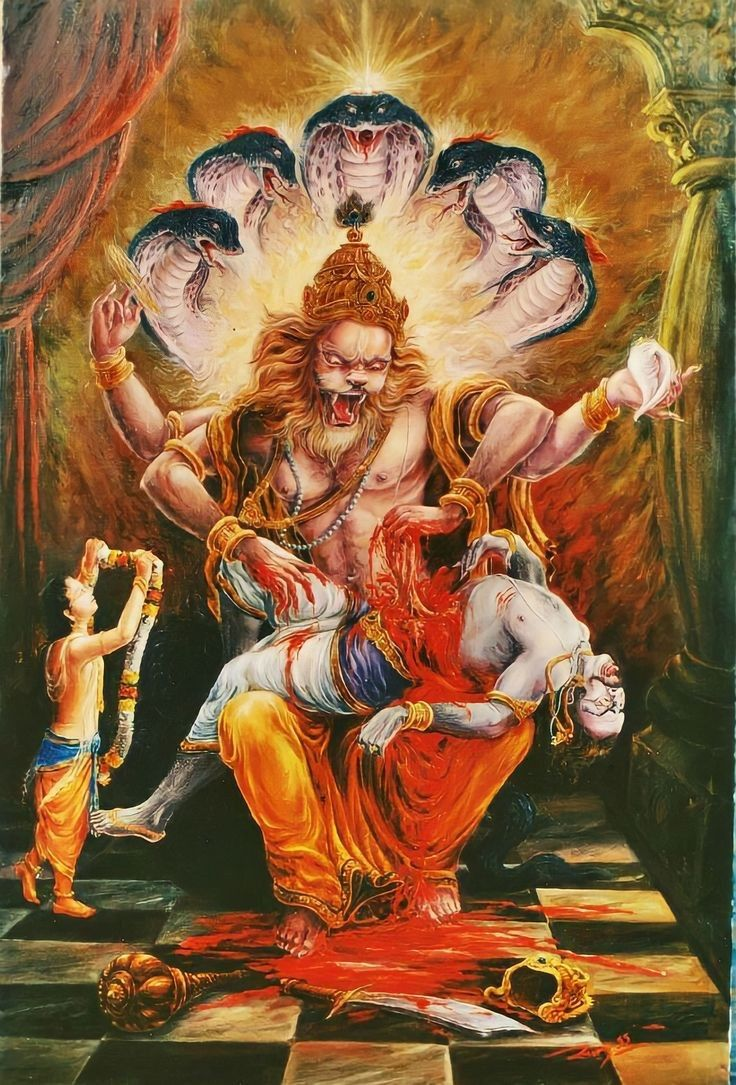
According to the Puranas, demon king Hiranyakashipu obtained a seemingly invincible boon from Brahma: he could not be killed by man or beast, inside or outside, day or night, on earth or in the sky, nor by any weapon. When he arrogantly kicked a stone pillar challenging his son Prahlada, the pillar split with a deafening roar. Lord Narasimha (neither man nor beast) emerged, dragged the demon to the threshold (neither inside nor outside) at twilight (neither day nor night), placed him on his lap (neither earth nor sky), and tore his chest open with His bare claws (not a weapon).
Following the slaughter, the Lord's cosmic fury (Ugra) terrified the universe. To pacify Him, Goddess Mahalakshmi incarnated as a beautiful hunter girl in the local indigenous tribe—Chenchu Lakshmi. Seeing her, the Lord's wrath melted into profound love. He married her, forever endearing Himself to the forest tribes.
Worship & Rituals
Because of the fierce nature of the deity and the wild terrain, the worship is highly disciplined, overseen by the ascetic Jeeyars of the Ahobila Matha. Yet, side-by-side with strict Vedic rituals, the deep-rooted, affectionate worship by the indigenous Chenchu tribe reveals a powerful, egalitarian spirituality where the Supreme Lord belongs just as much to the forest dwellers as He does to the scholars.
Festivals
The most unique and beautiful festival is the Paruveta Utsavam (The Mock Hunting Festival). To honor His marriage to Chenchu Lakshmi, the Utsava Murthy (processional deity) of the Lord is taken out into the deep forest. The local Chenchu tribal people are given the highest honors; they lead the procession, 'hunt' with bows and arrows, and celebrate their divine Son-in-Law visiting their ancestral home.
⏳ Daily Schedule
07:30 AM - 01:00 PM: General Darshanam
01:00 PM - 04:00 PM: Temples Closed
04:00 PM - 08:00 PM: Evening Darshanam
Recommended 1-Day Itinerary:
• 07:00 AM - 01:00 PM: Trek to 5 Core Temples (Upper Ahobilam: Ahobila, Jwala, Malola, Kroda, Karanja)
• 02:00 PM - 05:30 PM: Jeep/Taxi to deep forest shrines (Bhargava & Pavana)
• 06:00 PM: Lower Ahobilam shrines (Yogananda & Chatravata)
* Best time to visit is Oct-Feb. Forest trekking must end before sunset due to wildlife (tigers and bears).
Associated Shrines
Ahobila Narasimha (Upper)
The Main Cave Shrine
The earliest, self-manifested (Swayambhu) shrine where the ferocious Ugra form is worshipped.
Jwala Narasimha
The Epicenter of Fury
The exact spot of the killing. Nearby is 'Rakta Kundam', a reddish pool where the Lord washed His bloody hands. Higher up is 'Ugra Stambham', the cleft rock of the legendary pillar.
Malola Narasimha
The Peaceful Lord
A serene, beloved (Lola) form sitting with Goddess Lakshmi (Ma). The Utsava deity of this shrine travels with the Jeeyars of the Ahobila Matha.
Kroda (Varaha) Narasimha
The Boar-Faced Lord
A unique form combining a boar's face with a lion's body, believed to have retrieved the hidden Vedas from Pathala (the underworld) while holding Bhumi-Devi.
Karanja Narasimha
The Vision of Hanuman
Under a Karanja tree, Lord Hanuman meditated for Rama. Narasimha appeared holding Rama's bow (Saaranga) to prove that Rama and Narasimha are the exact same divine light.
Bhargava Narasimha
Parashurama's Penance
Lord Parashurama (Bhargava Rama) performed intense penance here to witness the Narasimha avatar and cleanse his sins from warring with Kshatriyas.
Yogananda Narasimha
The Great Teacher
A deeply peaceful form where the Lord, after calming His rage, sat in a meditative posture to teach the principles of Yoga to His devotee Prahlada.
Chatravata Narasimha
The Musical Patron
A uniquely joyful form with a broad smile and hand in 'tala mudra' (musical beat). He sits under a Peepal tree, having blessed the celestial Gandharva musicians Haha and Hoohoo.
Pavana Narasimha
The Purifier
Deep in the forest on the Pavani river banks. It is here He married Chenchu Lakshmi. Adi Shankara is said to have composed the famous 'Narasimha Karavalamba Stotra' at this very spot.