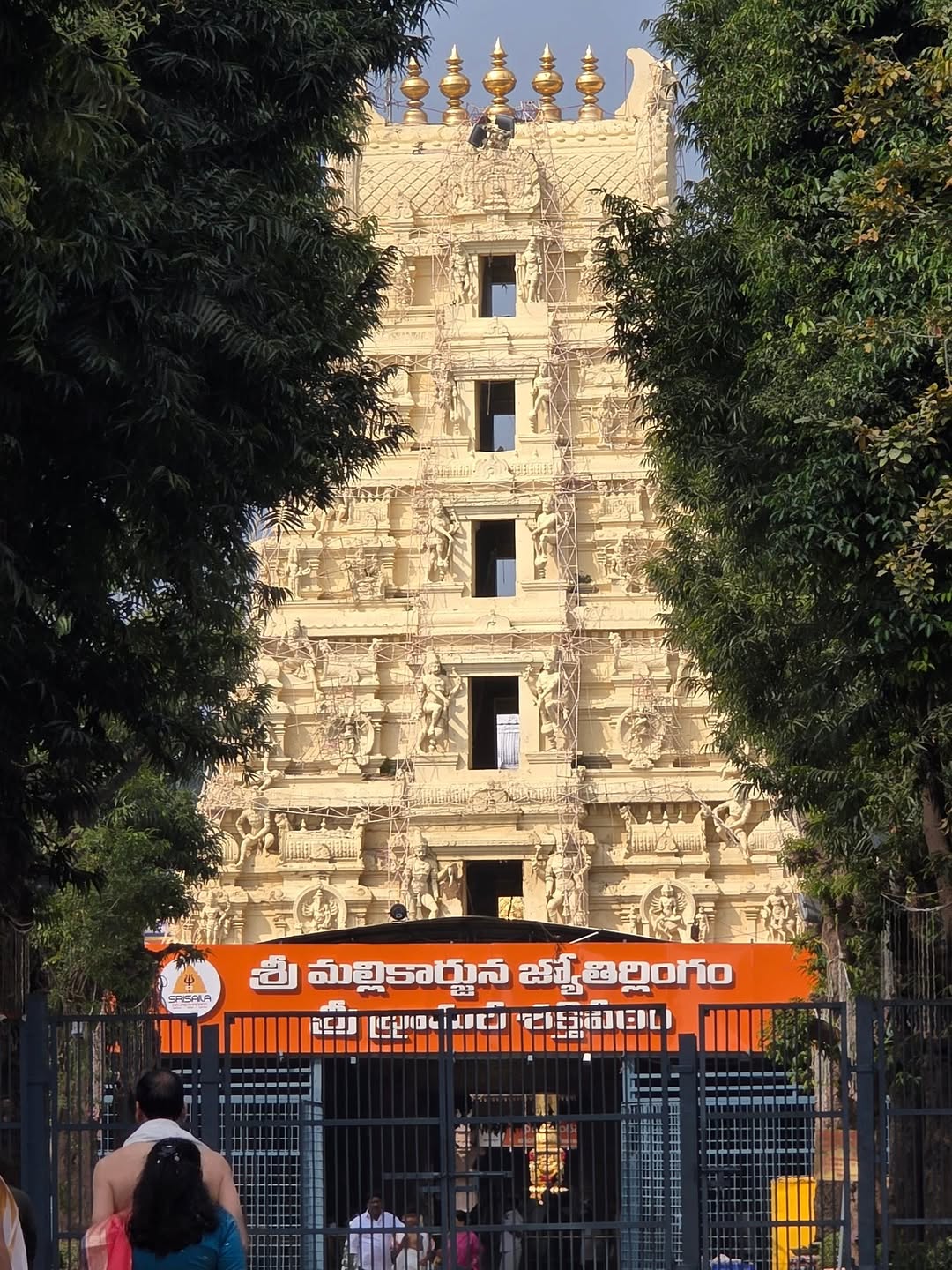
Srisailam, Andhra Pradesh
Mallikarjuna Swamy Devasthanam
Also known as: Srisailam Temple, Sri Bhramaramba Mallikarjuna Temple, Dakshina Kailasam
Nestled deep in the lush Nallamala Hills along the banks of the Krishna River, Srisailam is an incredibly rare dual-shrine. Revered globally as both a Jyotirlinga and a Maha Shakti Peeth, it is known as 'Dakshina Kailasam'. It is said that every evening, Lord Shiva's feet touch this very land, making it the only place on earth outside of Mount Kailash where Shiva walks daily.
The History
Historically, inscriptional evidence dates the temple back to the Satavahana dynasty (2nd century). The complex saw massive expansions under the Vhanni Reddi Kingdom (12th-13th centuries), who constructed the Veerasheromandapam and the steps to Paathalaganga. Later, modern additions like the spectacular gopurams were built by King Harihara I of the Vijayanagara Empire.
A defining moment in Bharat's history occurred here. When Chhatrapati Shivaji Maharaj climbed to Srisailam to stand before Goddess Bhramaramba, he didn’t just pray—he vowed to destroy Adharma. In response, the Goddess did not just bless him, she armed him. She gifted him the legendary divine sword (Bhavani Talwar / Khadgam), an event beautifully immortalized in a sculpture within the temple showing Shivaji kneeling before the Mother of the Universe.
Sacred Architecture
Fortified Dravidian Architecture
The Srisailam temple complex covers about 2 hectares and is built in a robust Dravidian style. It is uniquely enclosed by a towering, fortress-like outer wall known as the Prakaram. This wall is celebrated for its spectacular relief carvings featuring intricately sculpted elephants, horses, and scenes from the Shiva Purana.
Inside, the primary sanctum of Lord Mallikarjuna features a beautiful stepped pyramidal Vimana topped with a golden crest. Uniquely, the shrine of Goddess Bhramaramba is given equal architectural prominence and is located in an elevated enclosure just behind the Shiva temple, emphasizing their combined cosmic importance.
Legend of the Deity
The Jyotirlinga's manifestation is one of the most deeply emotional stories in Hindu tradition. Following a divine competition for the supreme post of the leader of the Ganas—offered by Lord Shiva to all the deities—Lord Ganesha emerged victorious through his supreme wisdom. Heartbroken and feeling slighted, Kartikeya left Mount Kailash in anger and meditated alone on Srisailam Hill. Unable to bear the separation, Lord Shiva and Goddess Parvati left Kailash to stay close to their son. They assumed the form of Mallikarjuna (Malli meaning white jasmine/Parvati, and Arjuna meaning Shiva). It is a poignant reminder that divine love does not end with distance, silence, or separation.
Simultaneously, this is a supreme Maha Shakti Peeth. When Lord Vishnu severed Sati Devi's body, a part of her (cited as the Neck or Upper Lip in varying texts) fell upon these hills. Later, when the demon Arunasura gained a boon making him invincible to two-legged or four-legged creatures, Parvati manifested as Goddess Bhramaramba—taking the form of a magnificent swarm of six-legged bees (Bhramari) to annihilate him and protect the cosmos.
Worship & Rituals
The temple also maintains an egalitarian tradition of Sparsha Darshanam, allowing devotees to physically touch the sacred Jyotirlinga.
Furthermore, the temple has deep ties with the local indigenous Chenchu tribe. According to local Shaiva lore, Lord Shiva fell in love with a Chenchu woman (an incarnation of Parvati) and had to prove his hunting skills to the tribe to marry her. To this day, the Chenchus affectionately call Lord Shiva 'Chenchu Mallayya' (their son-in-law) and are given special privileges in temple rituals, beautifully symbolizing the integration of forest and Vedic traditions.
Festivals
Ugadi (the Telugu New Year) is predominantly dedicated to Goddess Bhramaramba, attracting massive crowds from neighboring Karnataka and Maharashtra, maintaining ancient inter-state devotional ties.
⏳ Daily Schedule
06:00 AM - 03:30 PM: General Darshanam & Abhishekam
03:30 PM - 06:00 PM: Temple Closed (Cleaning/Alankarana)
06:00 PM - 10:00 PM: Evening Darshanam
10:00 PM: Ekantha Seva & Closure
Associated Shrines
Sakshi Ganapati Temple
Son of Mallikarjuna (Lord Ganesha)
Devotees must visit this temple first. True to his name, Lord Ganesha acts as the 'Witness' (Sakshi), keeping a spiritual record of every pilgrim who visits Srisailam to show to Lord Shiva.
Istakameswari Temple
Secret Forest Shrine
Hidden deep inside India's largest tiger reserve. Devotees must journey nearly 18 KM through the dense Nallamala forest with no roads and no signal—armed only with faith to reach this powerful, ancient site.
Shikhareswara Swamy Temple
Iconic Peak Shrine
Located at the highest peak of Srisailam. Viewing the main temple's Vimana from this breathtaking vantage point is said to grant instant Moksha.
Kumara Bhairava Swamy Temple
Guardian Deity
An ancient, deeply revered shrine associated with the origins of the Srisailam kshetram and its protection.
Patala Ganga
Sacred River (Krishna River)
The holy bathing ghats located deep in the valley below the temple, accessed via ancient stone steps built by the Reddi kings.