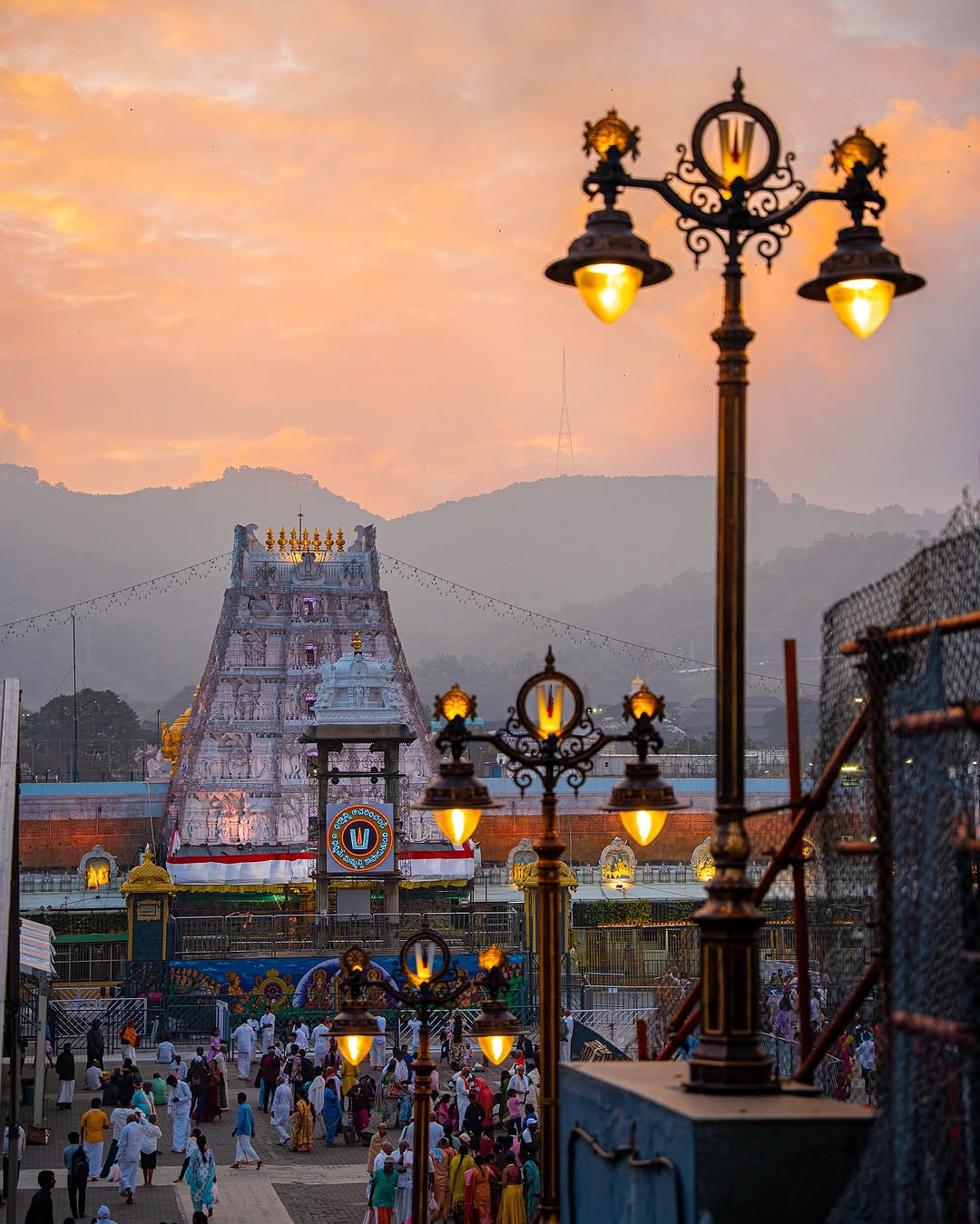
Tirumala • Seshachalam Hills • Tirupati, Andhra Pradesh
Tirumala Venkateswara Temple
Also known as: Tirupati Balaji Temple, Tirumala Temple
Sitting 853 meters above sea level in the Seshachalam Hills, Tirumala is an unparalleled spiritual phenomenon. With a net worth exceeding that of many nations, it is the second most visited religious site in the entire world (following Vatican City and Mecca). Dedicated to Lord Venkateswara, it is globally renowned for its massive scale of devotion, baffling scientific anomalies, and legendary Annaprasadam.
The History
According to Hindu belief, the temple is dedicated to Lord Venkateswara, an incarnation of Lord Vishnu, who is believed to have descended to Earth during Kali Yuga to guide and protect humanity. A popular legend states that he took a divine loan from Kubera for his marriage to Goddess Padmavati, which devotees symbolically help repay through offerings.
The temple’s origins date back to ancient times, with references found in early Tamil literature. Construction is believed to have started around 300 CE and was later expanded and enriched by powerful dynasties such as the Pallavas, Cholas, Pandyas, and the Vijayanagara Empire. Among them, Emperor Krishnadevaraya made significant contributions in the form of gold, jewels, and architectural expansions.
Architecturally, the temple follows the Dravidian style. The sanctum, known as Ananda Nilayam, houses the standing idol of Lord Venkateswara facing east. Worship is performed according to the Vaikhanasa Agama tradition, preserving ancient rituals and practices. The temple is also one of the 108 Divya Desams, making it highly sacred in Vaishnavism.
During medieval and colonial periods, the temple came under various administrations, including local rulers and later the British East India Company. Despite political changes, religious practices remained largely uninterrupted, reflecting the deep-rooted devotion of the people.
Today, the temple is managed by the Tirumala Tirupati Devasthanams (TTD) and is one of the richest and most visited religious centers in the world. It receives millions of devotees annually and provides extensive facilities such as queue complexes, Annaprasadam (free meals), laddu prasadam distribution, and accommodation services for pilgrims.
Beyond its physical and historical significance, the temple represents faith, surrender, and spiritual transformation. For many devotees, the journey to Tirumala—whether by foot or road—is as meaningful as the darshan itself.
Sacred Architecture
Dravidian Temple Architecture
The temple is built in the traditional South Indian Dravidian style, characterized by towering gopurams (gateway towers), intricate carvings, and a sacred geometric layout. The main sanctum, known as Ananda Nilayam, is covered with gold plating, symbolizing divine radiance.The temple stands on Venkatadri Hill, the seventh peak of the Seshachalam Hills, representing the seven heads of Adisesha. The layout follows strict Agamic principles, ensuring spiritual energy flow.
The temple complex includes mandapams (pillared halls), prakaram (circumambulatory paths), and the sacred Swami Pushkarini, which is believed to purify devotees before darshan.
Legend of the Deity
At the beginning of Kali Yuga, according to legend, sage Narada once observed a group of rishis performing a sacred yagna but they could not decide which of the Trimurti should receive its benefits. Sage Bhrigu was chosen to test them. He visited Brahma and Shiva but felt ignored, and finally went to Vaikuntha, where Lord Vishnu was in deep meditation with Goddess Lakshmi. Angered, Bhrigu kicked Vishnu on his chest. Instead of reacting with anger, Vishnu calmly apologized and humbly massaged the sage’s feet, destroying Bhrigu’s ego. However, Lakshmi, feeling insulted, left Vaikuntha and went to Earth.
Separated from Lakshmi, Vishnu descended to Earth and performed penance on Venkata Hill, meditating in an anthill near a sacred pushkarini. Later, he manifested as Srinivasa and was raised by Vakula Devi, the rebirth of Yashoda, thus fulfilling his earlier promise.
Meanwhile, Lakshmi was reborn as Padmavathi, the daughter of King Akasha Raja. Srinivasa and Padmavathi eventually fell in love. Vakula Devi approached the king and arranged their marriage. To conduct the grand celestial wedding, Srinivasa took a divine loan from Kubera, the god of wealth, symbolizing the eternal bond between the deity and his devotees.
After their marriage at Narayanavanam, Srinivasa and Padmavathi moved to Tirumala. Later, Lakshmi reunited with Vishnu, and both Lakshmi and Padmavathi chose to remain eternally with him in divine form. It is believed that they reside on his chest, while Lord Venkateswara stands on the sacred Tirumala hills, blessing devotees and guiding humanity through the challenges of Kali Yuga.
According to the Brahma Purana, Lord Venkateswara is not a sculpted stone idol. It is believed that the Lord, out of his own divine will, turned his physical body into stone (Swayambhu) to give eternal hope to humanity during the dark age of Kali Yuga. He chose to remain amidst his devotees, proving that no matter how much the world is destroyed, divine hope persists.
Because of this, Tirupati Balaji is revered as a 'Living Deity', and the sanctum exhibits incredible scientific anomalies that defy logic to this day:
✔️ The Warm Idol: Despite being at an altitude of 3,000 feet, the idol maintains a constant, human-like temperature of 110°F. The idol actually 'sweats', requiring the priests to constantly wipe away moisture, and necessitating an advanced, nature-driven cooling system inside the room.
✔️ The Ocean Sound: When devotees or priests place their ear against the back of the idol, the distinct sound of crashing ocean waves can be heard echoing from within.
✔️ The Real Hair: The deity is adorned with real hair that is miraculously smooth and never tangles.
✔️ The Eternal Lamps: Earthen lamps inside the sanctum have been burning continuously for over a thousand years without any oil being added.
✔️ The Disappearing Flowers: Flowers offered during specific sacred rituals inside the Garbhagriha mysteriously reappear 20 kilometers away at Yerpedu.
Worship & Rituals
Once at the temple, rituals follow the Vaikhanasa Agama tradition, with pujas performed six times a day.
A hallmark of the Tirumala experience is the world-renowned Tirupati Laddu. Prepared exclusively in the temple kitchen known as the Potu, this sacred sweet holds a Geographical Indication (GI) tag, ensuring it is made and sold only by the TTD.
Equally legendary is the temple's tradition of Annadanam (free food distribution). The Matrusri Tarigonda Vengamamba Annaprasadam Complex (MTVAC) is a massive, state-of-the-art dining facility named in honor of the 18th-century poetess and fierce devotee of Lord Venkateswara. Continuing her legacy of feeding weary pilgrims, the MTVAC serves delicious, piping hot, and free meals to nearly 100,000 pilgrims every single day, making it one of the largest free kitchens in the world.
Another profound form of worship here is Talaneelalu (the offering of hair). Over a ton of hair is collected daily. As per legend, when Lord Venkateswara was hit on the head, he lost a patch of hair. The Gandharva princess Neela Devi instantly cut her own hair to implant it on his scalp. Deeply moved, the Lord promised that all hair offered by devotees would be accepted by her. Today, the massive tonsuring centers (Kalyanakattas) accommodate tens of thousands of devotees daily, reflecting their absolute surrender to the divine.
Festivals
Vaikunta Ekadasi is another highly significant festival, where devotees believe that passing through the Vaikunta Dwaram leads to salvation.
Other major celebrations include Rathasapthami, Pavitrotsavam, and Pushpayagam, each reflecting devotion, purification, and gratitude.
Festivals at Tirumala are not just rituals—they represent the living tradition of devotion and divine connection.
⏳ Daily Schedule
03:30 AM - 04:00 AM: Thomala Seva (Flower Offering)
04:00 AM - 04:15 AM: Koluvu and Panchanga Sravanam
04:15 AM - 05:00 AM: First Archana (Sahasranama Archana)
05:30 AM - 06:30 AM: Visesha Puja (Mondays only)
07:00 AM - 07:00 PM: General Darshanam (Public Darshan)
12:00 PM - 05:00 PM: Special Sevas (Kalyanotsavam, Brahmotsavam, etc.)
05:30 PM - 06:30 PM: Sahasra Deepalankarana Seva
07:00 PM - 01:00 AM: Night Darshanam
12:45 AM: Ekanta Seva (Final nightly offering)
Associated Shrines
Vakula Matha Temple
Foster Mother (Vakula Devi)
Dedicated to the mother who raised Srinivasa. By tradition, Naivedyam (food offering) is spiritually presented here before being offered to the Lord at Tirumala.
Sri Bhu Varaha Swamy Temple
Adi Varaha (Form of Vishnu)
According to tradition, devotees must have darshan of Lord Varaha here before visiting Lord Venkateswara, acknowledging his ownership of the hills.
Srivari Padalu
The Divine Footprints
Located at the highest point of Narayanagiri Hill, these are the sacred footprints where Lord Venkateswara is believed to have first stepped onto the earth.
Silathoranam
Natural Rock Arch
A geological marvel dating back millions of years. This naturally formed arch is revered as the exact spot where the Lord entered the Seshachalam hills.
Papavinasanam & Akasha Ganga
Sacred Teerthams
Divine waterfalls. Papavinasanam is believed to wash away all sins, while the holy waters of Akasha Ganga are brought daily for the Lord's Abhishekam.
Chakra Teertham
Holy Water Body
A deeply spiritual site where Lord Brahma performed penance, cleansed by the power of Lord Vishnu's Sudarshana Chakra.
Padmavathi Ammavari Temple
Consort of Lord Venkateswara
A pilgrimage to Tirumala is considered incomplete without seeking the blessings of Goddess Padmavathi at her temple in Tiruchanur.
Tiruchanur
Sri Bedi Anjaneya Swamy Temple
Devotee of Lord Venkateswara (Hanuman)
Located opposite Tirumala temple; associated with protection and devotion
Sri Govindaraja Swamy Temple
Brother of Lord Venkateswara
Important temple managed by TTD, associated with temple traditions
Tirupati
Kapila Theertham
Sacred place dedicated to Lord Shiva
Holy waterfall and temple at Tirupati; part of pilgrimage circuit
Japali Hanuman Temple
Devotee of Rama/Vishnu
Hidden deep inside the Tirumala forest, this serene temple is where Lord Hanuman is believed to have performed intense meditation.
Srinivasa Mangapuram Temple
Form of Lord Venkateswara (Kalyana Venkateswara)
Associated with post-marriage stay of Srinivasa and Padmavathi
Sri Venu Gopala Swamy Temple
Form of Lord Krishna
A peaceful and ancient temple dedicated to Lord Krishna, located along the scenic route toward Papavinasanam.