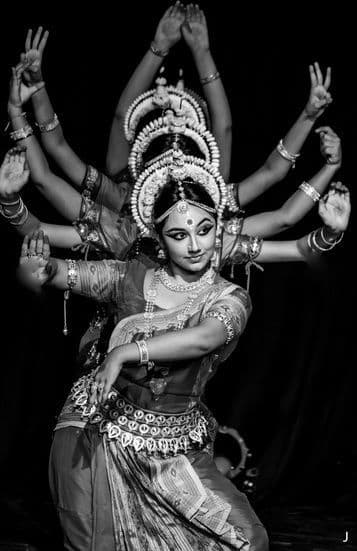
Odissi
The Lineage
Odissi is the oldest surviving classical dance in India, with roots traceable to the ancient Natya Shastra and 2nd-century BCE carvings in the Udayagiri caves. It was nurtured in the temples of Odisha by devoted women called Maharis. During periods of foreign invasion in the 17th century, the tradition expanded to include young boys called Gotipuas, who trained in athletic and martial art forms of the dance to entertain outside the temples. Like other classical dances, Odissi was severely suppressed and banned during British colonial rule. A massive post-independence revival, spearheaded by scholars and legendary gurus like Kelucharan Mohapatra, reconstructed the art form into the global phenomenon it is today.
Core Elements
- ✦Tribhangi (S-shaped 3-fold bend)
- ✦Chouka (Square squatting stance)
- ✦Mahari & Gotipua traditions
- ✦Bhangas (Symmetric body bends)
Where the hand goes, the eyes follow; where the eyes go, the mind follows.— Natya Shastra
The Margam (Sequence of Performance)
Mangalacharana
The invocation. Includes a hymn to Lord Jagannath, 'Bhumi Pranam' (salutation to Mother Earth), and the salutation to the gods, gurus, and audience.
Batu
A fast-paced, pure rhythmic dance performed in honor of Lord Shiva, without any accompanying song or recitation.
Pallavi
A sequence of slow, graceful, and lyrical movements of the eyes, neck, torso, and feet that slowly builds into a fast-tempo crescendo.
Abhinaya
The expressional dance. The dancer uses mudras and facial expressions to enact a song or poetry, most commonly the Radha-Krishna love poems.
Natya
A highly dramatic dance-drama sequence depicting Hindu mythologies, epics, and legends.
Moksha
The grand finale. A climactic, fast-paced pure dance that conveys a sense of spiritual release, salvation, and the liberation of the soul.
⚙️ Blueprint
Dancers wear brightly colored local silk saris (Pattasari, like Sambalpuri or Bomkai) with stitched front pleats for maximum footwork flexibility. Uniquely, Odissi uses silver jewelry rather than gold. The hair is drawn into an elaborate bun resembling a Hindu temple spire, decorated with a moon-shaped crest of white flowers or a 'mukoot' (reed crown with peacock feathers). Hands and feet are painted with red 'alta'.
Accompanied by traditional Odissi music, a 2,000-year-old tradition dedicated to Lord Jagannath. The orchestra is anchored by the Mardala (a traditional percussion drum) and the ubiquitous tanpura for a droning ambiance. Melodic instruments include the harmonium, bansuri (bamboo flute), sitar, and violin.
Odissi is a visual expression of spiritual ideas, particularly the sensuous and devotional love poems of the 'Gita Govinda' by the 12th-century poet Jayadeva. The dance utilizes 63 specific 'Hastas' (mudras) and focuses heavily on the 'Shringara' rasa (loving devotion). It is an art form designed to re-create the infinite, divine self through geometric symmetry.