Kuchipudi
The Lineage
Kuchipudi traces its origins to ancient traveling bards called 'Kusilava'. It evolved as a deeply religious Vaishnavism tradition in the 17th century when Siddhendra Yogi composed the masterpiece play 'Bhama Kalapam'. Unable to find female performers, he trained the young Brahmin boys of Kuchipudi village to execute the drama. For centuries, it remained a strict, all-male traveling troupe tradition where men played both male and female roles. After surviving the fall of empires and British colonial bans, a 20th-century renaissance led by Gurus like Vedantam Lakshminarayana Sastri opened the art form to women and pioneered solo performances, bringing Kuchipudi to the global stage.
Core Elements
- ✦Tarangam (Dancing on a brass plate)
- ✦Vachikabhinaya (Lip-syncing)
- ✦Kavutvams (Acrobatics)
- ✦Bhama Kalapam (Iconic play)
Where the hand goes, the eyes follow; where the eyes go, the mind follows.— Natya Shastra
The Margam (Sequence of Performance)
Melavimpu
The invocation. An on-stage prayer expressing reverence to Ganesha, the earth, and the guru to ensure a good beginning.
Pravesa Daru
The dramatic introduction of the characters. Actors are revealed from behind a curtain, historically accompanied by colored resin thrown into torch flames.
Nritta
The pure, abstract dance sequence. Dancers perform formalized units of motion (Adugulu/Karanas) rhythmically to a musical raga.
Shabdam
The transition into expressive dance (Nritya). Combines mime, footwork, and gesture to draw out the emotional taste (rasa) of the narrative.
Padam
The deepest emotional core of the play. Slower, lyrical dance expressing spiritual love, allegories, and intimate sentiments.
Tarangam
The spectacular climax. The dancer performs highly complex rhythmic footwork while balancing a water pot on the head and dancing on the rim of a brass plate.
⚙️ Blueprint
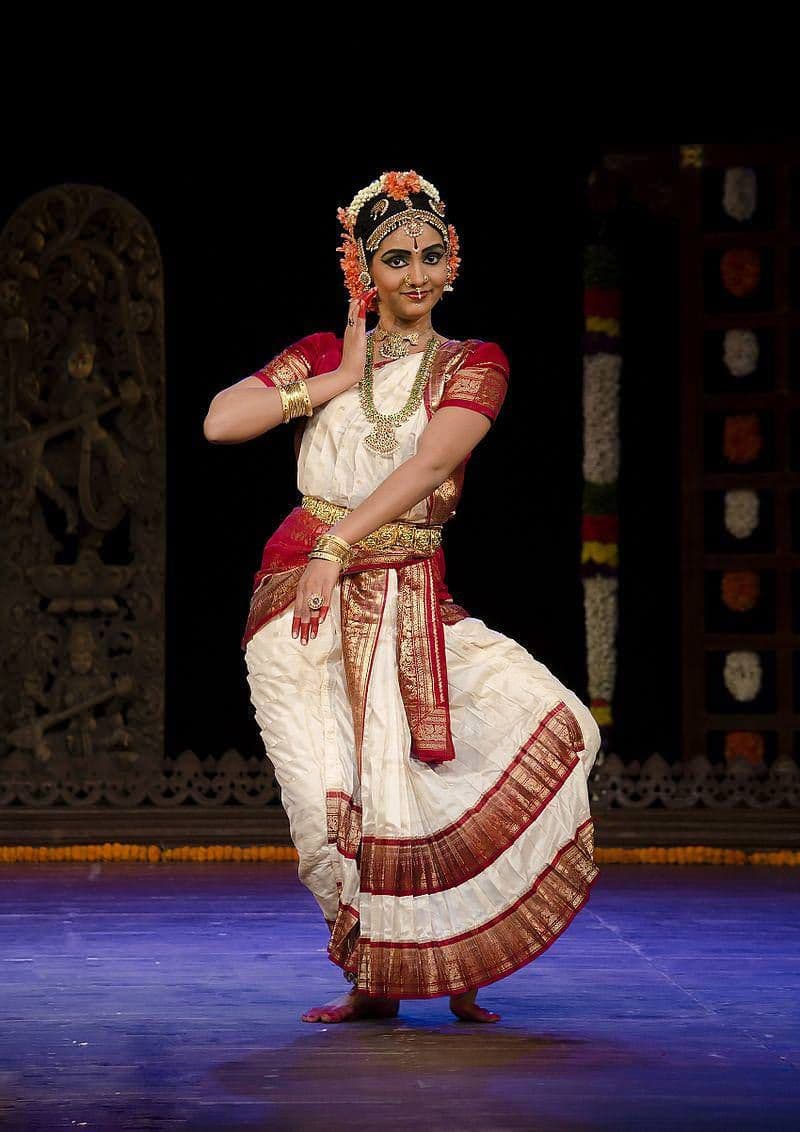
Historically performed by men in dhotis. Today, female artists wear brilliantly colorful saris (or body-fitting dresses) with a specially stitched pleated fan in the front to highlight exacting footwork. A metallic belt secures the waist. The hair is braided and adorned with Vedic sun and moon jewelry. Leather anklets (ghungroos) are worn for rhythm. Theatrical props are common, including water pots, lamps, or peacock crowns for the role of Krishna.
Accompanied by Carnatic music sung in the Telugu language. The performance is distinctly led by a conductor (Sutradhara or Nattuvanar) who humors the audience, explains the play, keeps the beat with cymbals, and recites rhythmic syllables. The orchestra includes the mridangam, flute, veena, and tambura.
Kuchipudi is a beautiful blend of 'Margi' (classical/spiritual) and 'Desi' (folk/sensual) styles. Unlike the rigid geometric perfection of other forms, it leans towards fluid, folksy, and sensual theatricality. The unique inclusion of 'Kavutvams'—where a dancer might paint a lion with their feet or dance with burning diyas—symbolizes supreme, unwavering concentration and devotion to the divine.