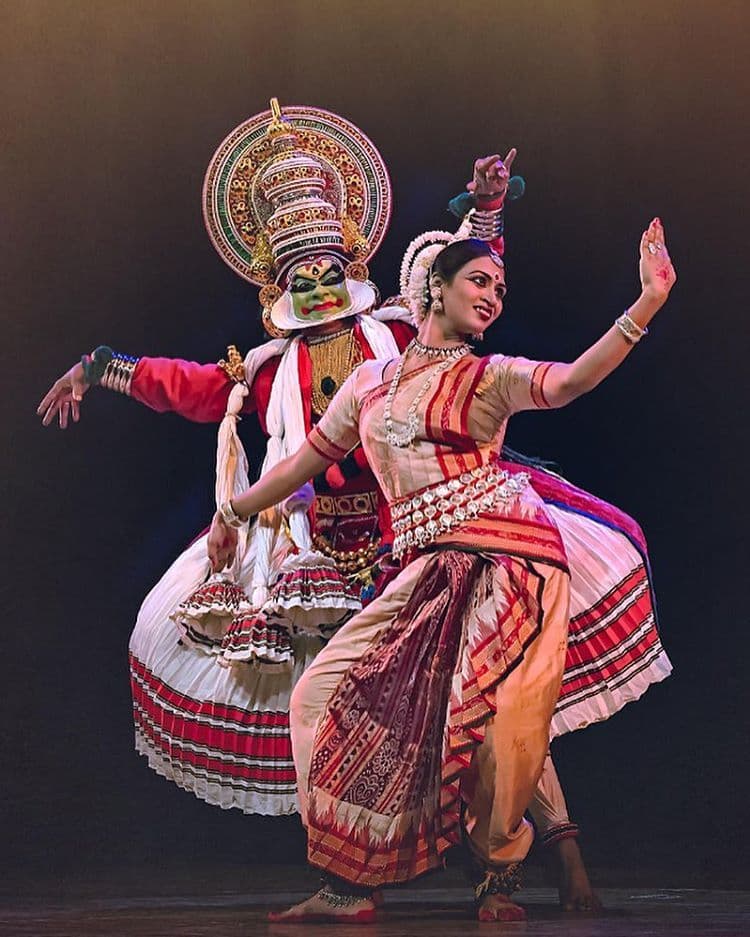
Kathakali
The Lineage
Kathakali emerged as a distinct genre in the 16th and 17th centuries in Kerala. Legend says it was born when a local ruler, Kottarakkara Thampuran, was denied a Krishnanattam troupe and created his own art form called Ramanattam (which later became Kathakali). Unlike other classical dances that developed in temples with the dancer also singing, Kathakali developed in royal courts and separated the vocalists from the actors. This allowed the dancers to focus entirely on intense, athletic choreography and complex sign language to dramatize the eternal fight between good and evil.
Core Elements
- ✦Chutti (Elaborate face painting)
- ✦Kireedam (Massive headgear)
- ✦Kalarippayattu (Martial arts base)
- ✦All-male traditional troupes
Where the hand goes, the eyes follow; where the eyes go, the mind follows.— Natya Shastra
The Margam (Sequence of Performance)
Kelikottu
The tuning of instruments and playing of rhythmic beats at dusk to signal to the village that the performance is about to begin.
Thodayam
A preliminary 'pure' abstract dance performed behind a curtain, without full costumes, focusing entirely on skill and motion.
Purappadu
A formal preliminary dance performed without the curtain, introducing the dancers in their full, magnificent costumes.
Melappadam
A musical interlude where the vocalists and drummers (Chenda and Maddalam players) showcase their highest technical skills.
Tiranokku
A dramatic tease and suspense entrance where a character (usually powerful or villainous) is slowly revealed from behind a hand-held curtain.
Attakatha
The main dance-drama. The vocalists sing 'Shlokas' (action descriptions) and 'Padams' (dialogue) while the actors bring the epic story to life.
Kalasham
Highly energetic, pure dance passages inserted between the acting sequences to cap off a scene or depict battles.
⚙️ Blueprint
Features the most elaborate costumes of all Indian classical dances. Dancers wear massive headdresses, vests, and heavy layered skirts. The highly symbolic makeup (Chutti) reflects Hindu Guṇa theory (personality traits): 'Pachcha' (Green) for noble heroes, 'Kathi' (Knife) or 'Thaadi' (Red beard) for evil villains, 'Kari' (Black) for demons, and 'Minukku' (Yellow/Orange) for females and sages. Traditionally, men perform all roles, adding a false top knot for female characters.
Vocals are traditionally sung in Sanskritized Malayalam. Uniquely, the vocalists stand at the front or side of the stage to deliver the lines while the dancer acts them out. The music relies heavily on powerful drums: the Maddalam (barrel-shaped), Chenda (cylindrical), and Idakka (hourglass-shaped, used for female characters).
Kathakali closely follows the ancient 'Hastha Lakshanadeepika' text. Actors speak entirely through a sign language of 24 main mudras and express the 9 emotional states (Navarasas) through intense facial and eye muscle control. The elaborate makeup is not just decorative; it is a psychological color code revealing the inner soul (Sattva, Rajas, Tamas) of the character.