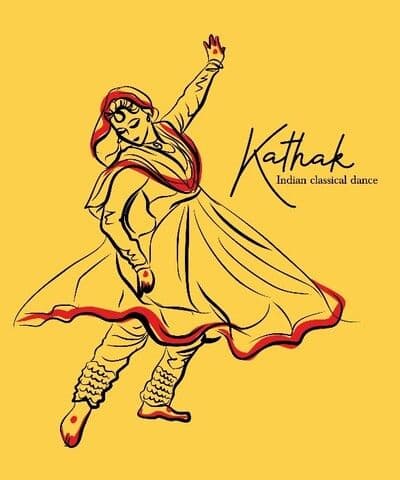
Kathak
The Lineage
Kathak traces its roots to 400 BCE and the 'Kathakars', ancient traveling bards who communicated Hindu epics through dance and song. During the Bhakti movement, it became heavily centered on the divine love of Radha and Krishna. In the 16th and 17th centuries, Mughal emperors patronized Kathak, bringing it from temple courtyards into royal durbars. This created a unique synthesis, adding Persian and Central Asian influences like whirling (similar to Sufi dance) and Urdu ghazals. After surviving severe moral policing and decline during the British Raj, Kathak experienced a major revival post-independence, maintaining its dual identity of Hindu devotion and Islamic courtly grace.
Core Elements
- ✦Chakkars (Rapid Whirls/Spins)
- ✦Tatkar (Intricate Footwork)
- ✦Straight-legged vertical stance
- ✦Three Gharanas (Styles)
Where the hand goes, the eyes follow; where the eyes go, the mind follows.— Natya Shastra
The Margam (Sequence of Performance)
Vandana / Salami
An invocation offering respect to the guru, musicians, and deities (or a 'Salami' salutation in Muslim court tradition).
Thàth
The opening of pure dance (Nritta) featuring slow, graceful, and highly controlled movements of the wrists, neck, and eyebrows.
Aamad
The formal, majestic entry into the rhythmic section of the performance.
Tukra, Tora & Paran
Fast-paced, pure technical dance compositions stressing footwork, gestures, and sharp head turns, synced to the Tabla.
Tatkar
The climax of pure rhythm, showcasing incredibly rapid, complex footwork where the dancer's ankle bells match the exact beat of the drums.
Gat Nikas
A brief mime or storytelling section expressed purely through stylized gait, walk, and stance.
Nritya
The expressive dance stage. A slower, deeply emotional performance acting out legends, Bhakti themes, or ghazals through facial expressions.
⚙️ Blueprint
Uniquely features both Hindu and Muslim variations. The Hindu female dress includes a specialized sari drape or a flowing 'lehenga' (skirt) with a choli and transparent veil. The Muslim female dress features an 'anarkali' tunic or a skirt over 'churidar' pyjamas. Males wear a silk dhoti (Hindu) or a kurta-churidar/angarkha (Mughal). All dancers wear heavy rows of ankle bells (Ghungroos) which are absolutely essential for the rhythmic footwork.
Accompanied by North Indian Hindustani classical music, prominently featuring the Tabla (hand drums) to perfectly sync with the dancer's footwork. The ensemble also includes the Sarangi, Harmonium, and Manjira (hand cymbals). The musical styles range from ancient Hindu Dhrupad to Persian-influenced Urdu Ghazals.
Kathak's Abhinaya (expressions) focuses heavily on subtle movements of the eyes and eyebrows to communicate the story. It is more introverted and withdrawn compared to Southern dances. It beautifully symbolizes the love between the Atman (soul) and the Supreme source through the metaphor of Radha and Krishna, while also embracing the mystical whirling found in Sufi traditions.