Bharatanatyam
The Lineage
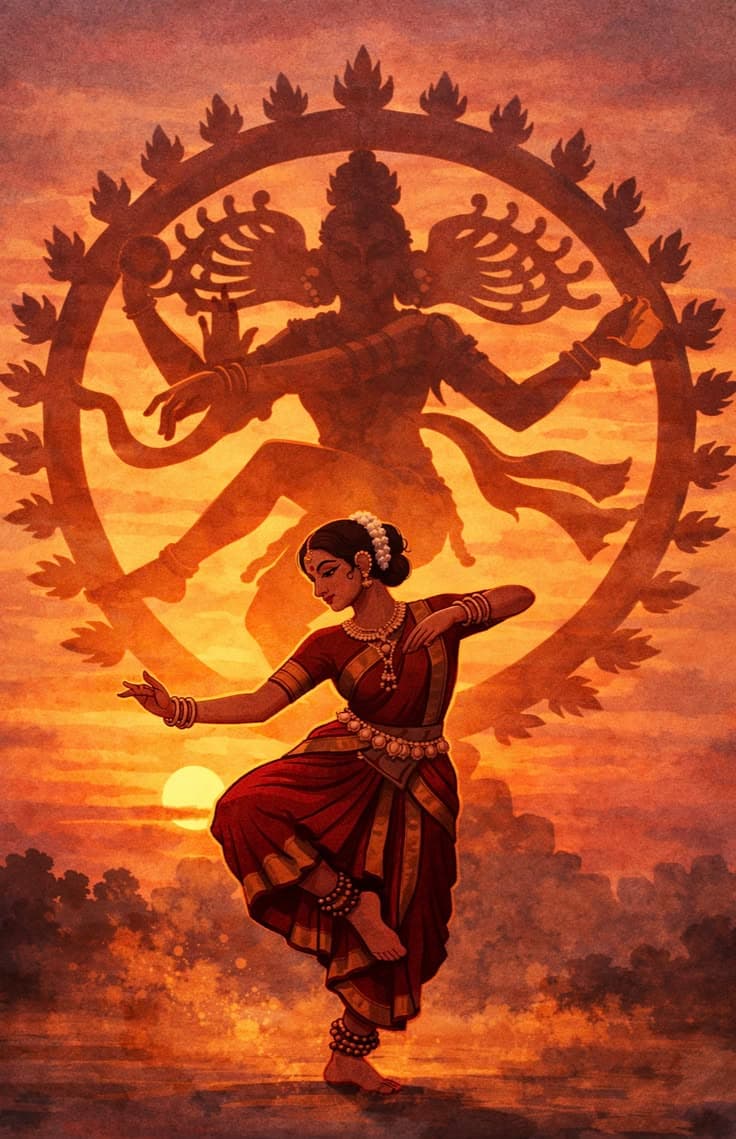
Bharatanatyam (formerly Sadiraattam) is the oldest classical dance tradition in India. Its theoretical foundations date back to the Natya Shastra. For centuries, it was an exclusive, spiritually devotional dance performed by Devadasis in the Hindu temples of Tamil Nadu. In 1910, the British colonial government banned temple dancing, stereotyping the art form. However, a powerful revival movement led by activists like E. Krishna Iyer and Rukmini Devi Arundale in the 1930s democratized the art, bringing it from the temple sanctum to the modern stage. The name 'Bharatam' is famously seen as a backronym combining 'Bhavam' (emotion), 'Ragam' (melody), and 'Talam' (rhythm).
Core Elements
- ✦Aramandi (Basic half-sit posture)
- ✦Bha-Ra-Ta (Bhavam, Ragam, Talam)
- ✦Mudras (Coded hand gestures)
- ✦Salangai / Ghungroos (Musical anklets)
Where the hand goes, the eyes follow; where the eyes go, the mind follows.— Natya Shastra
The Margam (Sequence of Performance)
Pushpanjali
Offering of flowers and salutations to the deities, guru, and audience.
Alarippu
A pure, rhythmic warm-up invocation without melody.
Jatiswaram
A technical performance uniting music, rhythm, and movement.
Shabdam
The introduction of expressed words and short devotional compositions.
Varnam
The longest, core expressive centerpiece combining complex footwork and storytelling.
Padam
A deeply emotional, slower stage of reverence and devotional prayer (bhakti).
Tillana
The rhythmic climax, returning to pure, fast-paced movement.
⚙️ Blueprint
Resembles a traditional Tamil Hindu bridal dress, featuring brightly colored silk with gold or silver zari embroidery. It often includes a stitched pleated front that opens like a hand fan during knee bends. Dancers wear elaborate temple jewelry representing the sun and moon, outline their hands and feet with red 'alta' or 'kumkum' to highlight gestures, and wear leather anklets with bells called 'salangai' (ghungroos) to emphasize rhythm.
Accompanied by South Indian Carnatic music. The performance is conducted by the 'nattuvanar' (often the guru) playing cymbals. The orchestra typically includes the mridangam (double-sided drum), nadaswaram, flute, violin, and veena, with verses recited in Tamil and Sanskrit.
Follows the four aspects of Abhinaya: Angika (body language), Vachika (song), Aharya (costumes), and Sattvika (emotional connection). It utilizes an extensive vocabulary of 'Hastas' or 'Mudras' (hand gestures) to act out epics. The form is deeply connected to modern yoga, incorporating over 20 asanas (including Natarajasana), making it a true form of Bhakti Yoga.